

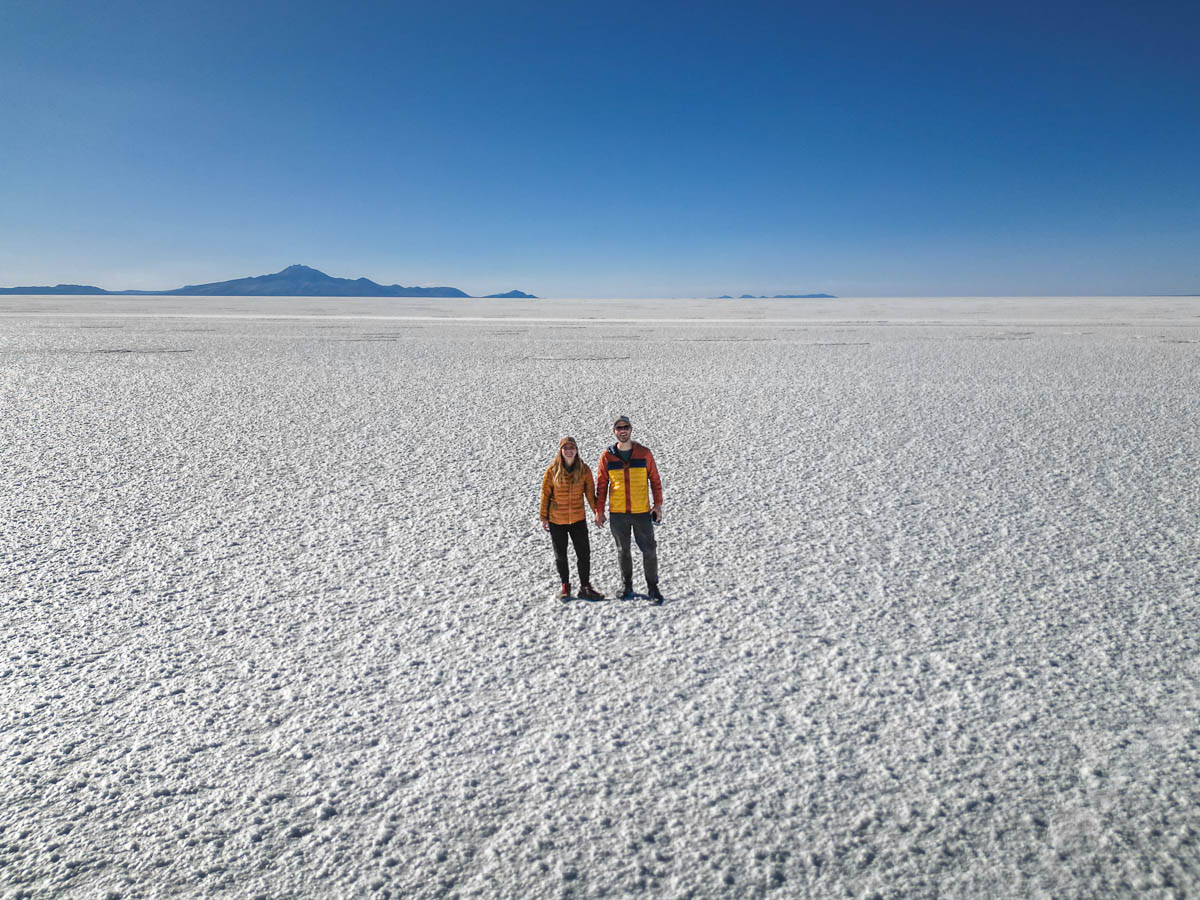
The most popular destination in the colorful country of Bolivia is the Uyuni Salt Flats (or Salar de Uyuni), which also hold a bunch of impressive titles, including being the flattest place AND the largest salt flat on the planet (you can actually see them from space!). As you might expect, these salt flats are quite remote, with only a handful of tiny towns sprinkled throughout this region. Accordingly, most travelers that are exploring the salt flats base themselves in Uyuni, a small city in southern Bolivia that’s located along their edge.
If you want to experience the salt flats and the surrounding otherworldly landscape for yourself, here are 21 awesome things to do in Uyuni, Bolivia.
This post may contain affiliate links. If you make a purchase through them, we may receive a small commission, for which we are extremely grateful, at no extra cost to you.
How to get to Uyuni, Bolivia
There are countless ways that you can get to Uyuni, but most visitors typically get there either via Bolivia’s largest city, La Paz, or tacked on after an Atacama Desert itinerary, an epic landscape in Northern Chile that shares many similarities to the Uyuni Salt Flats and the surrounding desert.
From La Paz
For visitors who only have a short amount of time in this incredible country, most visitors include Uyuni in their Bolivia itinerary as a side trip from the largest city in the country, La Paz. This is exactly what my husband, Justin, and I did—we made our way down all through Peru, to Copacabana, Bolivia, down to La Paz and finally, on to Uyuni.

There are SO many cool things to do in La Paz, but squeezing in a trip down to Uyuni is definitely worth it. Here’s how you can get there from La Paz.
Bus
If you want to travel there independently or plan on meeting up with a tour group down there, it’s easy to grab a bus from La Paz’s station to Uyuni. It’s typically an eight to nine hour overnight bus ride, arriving in Uyuni in the early morning, so I’d strongly recommend springing for a bus with a large seat that leans back that you can sleep in (El Cisne is a great option!).
Train
While this isn’t the most direct or fastest way to get to Uyuni, a popular method is to actually hop on a train, which chugs along through stunning parts of the country.

To get to the train, you’ll first need to hop on a four hour bus from La Paz to the city of Oruro. From the Oruro train station, there are only four departures to Uyuni per week, with two daytime departures and two nighttime departures. If you’re bothering to take the train to see the scenery in Bolivia, you’ll obviously want to take one of the trains that leave during the day, which is typically on Tuesdays and Fridays at 2:30 PM.
The trains are relatively comfortable, with a restaurant car and nice big windows, where you can look out as you zoom past flamingoes, remote villages, llamas, and quinoa fields. The ride lasts for about seven to eight hours.
Air
If money is of no concern, you can fly from La Paz to Uyuni. The flight is typically about one hour and costs around $300-$350 USD roundtrip.
Tour
To be honest, one of the most popular things to do in La Paz is to join one of the Uyuni Salt Flats tours. There are tour operators that handle everything about your trip to Uyuni, from picking you up in La Paz to helping you explore around the salt flats to dropping you back off at your hotel.

After doing a ton of research, this is exactly what we did—since all of the buses from La Paz to Uyuni arrived at 6 or 7 AM in the morning, we didn’t want to just aimlessly wander around the city after a night of questionable sleep, looking for a tour operator to take us around the salt flats.
And it worked out GREAT—our tour operator made traveling to the salt flats and the surrounding desert seamless (they even arranged for us to have a hotel room waiting for us in Uyuni when we first arrived, so we could take a quick nap) and showed us the very best places in southern Bolivia.
Here are some tours from La Paz to Uyuni to consider:
- Uyuni Tour: This is the exact tour that we did, with essentially three full days exploring the Uyuni Salt Flats and the surrounding desert with an overnight bus tacked on to either end of the trip to get back and forth from La Paz. We saw and did SO much during this trip and the transportation from La Paz to Uyuni was an absolute breeze. I know not everyone will be able to devote five days to exploring this area, but if you can, DO IT!
- 4 Day Tour to Uyuni from La Paz by Air: This tour is offered by the same operator that we went with and is effectively the same itinerary that we did, with three full days in the Uyuni Salt Falts, but includes flights instead of overnight bus trips, if you have a bigger budget or suck at sleeping on buses as much as we do.
- Visit Uyuni from La Paz: If you only have one full day to spend in Uyuni, this is a great option, where you’ll take an overnight bus to Uyuni, spend all day exploring, and then take another overnight bus back to the city. It’s definitely the best way to squeeze a LOT into just a short period of time in Bolivia!

From the Atacama Desert
Many people who are exploring South America for a few months start in the stunning Atacama Desert of Chile (which, if it’s not on your bucket list yet, add it!) and then continue to head up north to Uyuni.
To explore the Atacama Desert, most people base themselves in San Pedro de Atacama, a small town that’s centrally located between all of northern Chile’s salt lagoons, hot springs, and otherworldly landscapes. There are tons of incredible things to do in San Pedro de Atacama, but once you’re done exploring this gorgeous area, here’s how you can make your way up to Uyuni.
Tour
There’s unfortunately no straightforward way to catch a bus between San Pedro de Atacama and Uyuni, so the easiest way to get there is on a tour that departs from the Atacama Desert, driving through and exploring the deserts of southern Bolivia and ending in Uyuni.

Here are some tour options from San Pedro de Atacama to Uyuni to consider:
- 3 day tour to Uyuni: On this tour, you’ll be picked up in San Pedro and driven to the desert in the south of Bolivia, stopping over the next three days at the stunning hot springs, geysers, and mountainscapes along the way, as you drive north to end your tour in Uyuni.
- 3 day Uyuni Salt Flats tour: This is another option to get you from San Pedro, through the desert and salt flats, up to Uyuni over the course of three days.
Air
From San Pedro de Atacama, you can drive yourself in a rental car or catch a transfer, like this shared option or this option, to the El Loa Airport in the nearby city of Calama, Chile.

Pretty much all flights from Calama have to first connect through Santiago, Chile, and, similarly, pretty much all flights to Uyuni must first connect through La Paz, so, at a minimum, you should expect to have two layovers in each of these cities, with the total flight route taking, at a minimum, 36 hours.
So not exactly the most efficient from a time or cost perspective, but a good option if you don’t want to go on a tour.
Insider tip: Before transiting from Chile, be sure to double check whether your country requires a visa in Bolivia and what kind of documents you’ll need, if any. We’re from the U.S. and had to go through a pricey and involved visa application process at the Bolivian border, so much so that our bus from Peru abandoned us at the immigration office. You can check your country's visa requirement here.
How to get around Uyuni, Bolivia
The city of Uyuni is not massive—to drive from one side of the town to the other, it takes about 15 minutes. So, if you need to get someplace in the town of Uyuni, you can either get a rental car or arrange for a taxi, which your hotel will be happy to connect you with.
However, most of the stuff that’s worth seeing in the salt flats and the surrounding desert is located outside of Uyuni, mostly on completely unpaved and unmarked pathways, quite literally in the middle of nowhere in the barren desert, with nothing, including gas stations or anything even resembling a road, around for hours and hours.

Accordingly, I would strongly recommend going on a tour, with knowledgeable guides who know where they’re driving and can fix any kind of automotive issues when you’re hours and hours away from cell service or an automotive shop.
During our trip around Uyuni, our tour guides zipped across sand dunes and rocky washes, with seemingly nothing to indicate that we were driving on an actual road, and spent over an hour fixing a clogged fuel filter and a blown tire on two of our group’s three Land Cruisers.

If your only goal is to explore the Uyuni Salt Flats, you could probably get away with driving yourself around in a high clearance, four-wheel drive rental car fine (just make sure that your rental car company allows that!), but, if you want to see anything in the surrounding area beyond that, you should absolutely be going with a knowledgeable guide.
If you’d prefer to just get to Uyuni by yourself and meet up with a tour group there, here are some options to consider:
- 3 Day Uyuni Tour: This three day tour of the salt flats and the surrounding desert includes pick up in Uyuni and guides who are incredibly passionate about Bolivia and its beautiful landscapes.
- One Day Uyuni Tour: If you don’t have as much time to dedicate to exploring this area, this is a great tour that showcases the highlights right around Uyuni, like the salt flats, train graveyard, and rustic salt factories.

Things to do in Uyuni, Bolivia
1. Explore the Train Cemetery
One of the most popular things to do in Uyuni itself is stop in the train graveyard, a collection of rusted out locomotives and cars that lay abandoned in the desert.
While the city is now known for its proximity to the salt flats, it was once recognized as one of the most important transportations hubs in South America. There were even plans to expand the train network here further in the early 19th century, but this idea was eventually abandoned, due to the area’s remote location and rising tensions with the surrounding countries. So, over 100 trains were left behind on the outskirts of town, slowly turning into rusty shells against the barren desert backdrop.

Now, you can climb inside or even on top of these derelict cars, which makes for some very cool photo opps (and would be an absolute DREAM for a train geek!).
2. Stay at a salt hotel
Whilst exploring the largest salt flats in the world, what better place to stay than a hotel made out of salt?
There are a handful of hotels in Uyuni whose walls and even beds are totally built out of bricks of salt. Even with this quirky aspect, you’ll still have all the modern day comforts, like a comfy mattress, hot showers, flushing toilets, and complimentary breakfasts.

Here are a few options to stay in:
- Hotel Boutique Andina: We stayed in this little boutique hotel, on the outskirts of town, which had huge cozy beds, an incredible complimentary breakfast spread, and friendly staff. Most of the rooms and beds are made with salt bricks, but you’ll still find all of the creature comforts you need.
- Hotel de Sal Luna Salada: For something even more unique, this hotel is located outside of Uyuni, close to the salt flats and is made almost entirely out of salt. You’ll find boho touches here, like cozy hammocks and butterfly chairs; an indoor pool overlooking the salt flats, and cool glamping options, like a geodesic dome with an open view of the sky for incredible stargazing opportunities.
- Hotel Palacio del Sal: This is the bougiest hotel in Uyuni that just so happens to be located right on the edge of the Salar de Uyuni and largely constructed out of salt blocks, with lots of luxurious onsite amenities, like a heated pool, spa, and onsite coffee shop.
3. Try Bolivian food
Uyuni isn’t exactly known for its food scene, but, like any touristy town, there’s plenty of decent restaurants to choose from that dish up authentic Bolivian cuisine.

One of our favorite dishes in the country is called a salteña, a type of empanada that’s stuffed with a comforting soup-y filling and sealed with a charred shell. You can try them for yourself at the Salteñaria La Cabaña, where a sweet older gentleman makes these little savory treats by hand.
4. Explore Colchani
Right at the edge of the Uyuni Salt Flats is the tiny town of Colchani, which is home to Bolivia’s largest salt processing cooperative.
While you’re in town, you can see a historic processing plant, completely built of salt bricks, as well as an artisanal market to buy homemade salt and textiles made from llama and alpaca wool.

There are also a handful of small museums that have a distinctly homemade kind of vibe, including the Museo de La Sal y La Llama, which highlights the importance of the llama in Bolivia, and the Salt Sculpture Museum, which, true to its name, has some impressive works of art carved out of salt.
5. Get ridiculous photos on the Uyuni Salt Flats
Given that this is the flattest place on Earth, one of the most iconic things to do in the Uyuni Salt Flats is to have a bit of fun with perspective and depth of field in photos—i.e., where you can easily make it look like a tiny dinosaur figurine is chasing you around the salt flats.

The guides for most tours around the Uyuni Salt Flats will bring along some fun props and be committed to getting some ridiculous photos of you.
Alternatively, if you’re visiting the salt flats by yourself, I’d recommend bringing along some items that you can play aorund with, like a wine bottle, spoon, cup, or Pringles can (plus your imagination!) to get some iconic photos here.
6. Visit the Dakar Bolivia Monument and Plaza de las Banderas Uyuni
On the actual salt flats, you’ll find the Dakar monument, which commemorates when the Dakar Rally, an endurance off-road race, zoomed through the Uyuni Salt Flats, starting in 2014.
Next to this monument, you’ll also find the Plaza de las Banderas Uyuni, with dozens of colorful flags flapping on nearby poles that symbolize the community of Bolivia and its neighboring countries.

This is a popular stop for tour groups, given that the first ever salt hotel on the planet is also located nearby. You unfortunately can’t stay here any longer, but it’s now used as a bathroom stop and dining hall, complete with chairs and tables made out of salt. There’s also a handful of vendors here, hawking products like homemade salt and ponchos, if you’re looking for something to remember your time in the Salar de Uyuni.
7. Hike in on Isla Del Pescado
One of the most popular things to do in the Uyuni Salt Flats is to stop at Isla Incahuasi, a unique rocky outcropping in the middle of the salt flats that is covered by a species of cactus, called giant cardon, that can grow up to 10 meters tall. These cacti are SO cool—they only grow at a rate of about a centimeter per year, but, since they live such a long time (hundreds of years!), they get to be absolutely enormous!

Today, there’s a short trail that winds through the cactuses, up to the outcropping’s rocky summit, which provides stunning views of the surrounding salt flats and, in the distance, the Andes Mountains. We hiked along this trail right before sunset and it was absolutely beautiful here, with the cactuses glowing in the golden-y light.
8. Watch sunset on the world’s biggest mirror
From December through April, during Bolivia’s rainy season, the Uyuni Salt Flats flood and become the world’s largest natural mirror. This effect kind of makes you feel like you’re “walking on the sky”, thanks to the water’s perfect reflections of the clouds and sky above.

The best time to see the mirror effect is January and February. However, even when we visited in June, our tour guides were still able to drive to a certain part of the flats that were flooded with a thin layer of water—it was SO special to wade through the water, as it was lit up with the punchy colors of the setting sun.
This looks SO cool to see, but visiting during prime flooding season doesn’t come without risks. You, of course, have a better chance of encountering rainy weather (which is never fun when all you’re doing is exploring outdoors) and certain parts of the salt flats, including Isla del Pescado, often become inaccessible, due to the floods.
9. Visit the Tunupa Volcano
The Tunupa Volcano is located just north of the Uyuni Salt Flats, in an area where most tours don’t go.
However, if you specifically book a tour that goes here, like this one day option or this two day excursion, or decide to drive here independently, you’ll get to see the volcano’s colorful slopes, which are considered sacred by Indigenous Bolivians. The volcano actually gets its name from the god of lightning and volcanoes of the Tiwanaku, who were pre-Inca people who lived around Lake Titicaca in northern Bolivia.

There’s a few ways to enjoy the Tunupa Volcano, including a short trail that leads to a viewpoint overlooking the Salar de Uyuni; a hike to a cave that houses seven 500 year old Inca mummies; or a steep and challenging hike that ascends to the volcano’s crater (we’ve had friends that did this trek and loved it, so we’re kicking ourselves that we missed it!).
Pssst.... everything listed above could theoretically be reached with a high clearance, 4WD rental car on your own, given that it's located in Uyuni, the salt flats, or the area immediately around it. Everything listed below requires driving down the aforementioned non-existent roads in the middle of nowhere, which is not something I would recommend doing without a knowledgable guide.
10. Climb over volcanic formations at the Valle de las Roca
Valle de las Rocas offers a valley full of cool volcanic rock formations, sculpted over the centuries by wind erosion. All of these funky formations sit in the shadow of the massive Uturuncu Volcano, which towers over 19,000 feet above.

There are no established hiking trails here but you are free to climb and snake your way through the maze of reddish formations here, making this feel like a fun jungle gym for adults.
11. Marvel at the Ciudad Encanto
Ciudad Encanto is a unique collection of dramatic stone monoliths, carved over millenia by rain. You can actually walk between these towering formations, winding your way past craggy hoodoos and exploring the maze-like passageways and caves carved into their bases along the way.
This is definitely a more off-the-beaten path location around the Salar de Uyuni and is most frequently included as a stop on Uyuni tours from the nearby city of Tupiza, like this 4 day option. We unfortunately didn’t stop here during our time in Uyuni but had friends that did and it looked absolutely EPIC!
12. Spot wildlife at Laguna Colorado
Pretty much any tour through the area around Uyuni includes a stop at Laguna Colorado, a shallow salt lagoon with a shocking pink color, thanks to volcanic sediments and colorful algae found in the water. The landscape here is absolutely breathtaking, with the lake sitting in the shadow of the towering Andes Mountains.

The lagoon is located in Eduardo Avaroa Andean Fauna National Reserve, which, true to its name, is an incredible place to spot wildlife. Three of the world’s six species of flamingoes call Laguna Colorado home, thanks to the large populations of plankton found in the water. This is also a great place to see vicuñas, which are relatives of llamas that live on the arid slopes of the nearby mountains.
We watched the sunset here and it was so incredibly gorgeous, with the dramatic color of the water and the abundance of wildlife, that I literally started to cry. In my opinion, this is one of the must-stop places in the Uyuni area!
13. Explore the Reserva Nacional de Fauna Andina Eduardo Avaroa
Beyond Laguna Colorado, this reserve sprawls across 7,147 square kilometers of southern Bolivia, with seemingly endless colorful mountains and otherworldly-looking salt lagoons. It’s not unusual to stumble across a handful of vicuñas, strolling across the desert, or a lagoon with dozens of flamingoes (fun fact: did you know that a flock of flamingoes is called a flamboyance?!).

For example, Laguna Pastos Grandes is a pool of electric blue water, with salt encrusted shores, that’s an excellent place to spot flamingoes. Alternatively, the Siloli Desert houses some of the most colorful mountains in South America, with pastel hued sediments painted across their slopes.
14. Stand under the Árbol de Piedra
The Árbol de Piedra is a funky rock formation, which has been carved by wind erosion to resemble a surreal tree. The formation—whose base consists of a soft quartz stone while the upper portion consists of a more erosion-resistant rock with a high iron concentraiton—stands at an impressive 5 meters tall, against the dramatic backdrop of the Andes Mountains.

You’re not allowed to climb on the Árbol de Piedra, due to its delicate base, but it’s surrounded by tons of other unique rock formations that you can scale to your heart’s content!
15. Spot chinchillas
Confession—before visiting Bolivia, I only knew of chinchillas in the context of vintage fur coats and had no idea where they lived or even what they looked like. So color me surprised when part of our tour around the Salar de Uyuni included stopping at a cliffside that was crawling with them!
Chinchillas kind of look like an adorable rabbit that’s somehow grown the tail of a squirrel. Unfortunately, they’re considered a threatened species, with their population declining over 90% since 2001, due to overhunting by humans for their fur.

They live in burrows or crevices of rock walls and can be found in the Reserva Nacional de Fauna Andina Eduardo Avaroa here and here, as well as throughout Chile.
These little creatures are SO cute, but please don’t feed, touch, or otherwise harass them. The ones we saw were clearly begging for food—beyond that being bad for any wildlife, it’s especially dangerous for animals that are specifically being overhunted.
16. Wander around the Salvador Dali Desert
This barren desert, also found in the Eduardo Avaroa reserve, is located in a barren valley, with lots of unusual rock formations that resemble the landscapes painted by the surrealist artist, Salvador Dali.

The painter never actually visited this particular desert—or even Bolivia, at all—but did create works that feature arid dramatic landscapes, similar to the ones you’ll find around the Salar de Uyuni.
We enjoyed walking around the desert floor for a bit, but, honestly, even just driving through this landscape, with the giant mountains, with their slopes painted with muted colors, and past the funky rocky formations was incredible!
17. Take a photo of Laguna Blanca
Laguna Blanca is located right along the Chilean border and is so named, after its milky, ice-blue waters, all surrounded by massive snow-capped volcanoes. Its unusual coloration comes from the concentration of borax that’s found in the waters.

This is another incredible place to spot flamingoes, especially during the rainy season. When we visited in June, the flamingoes had already migrated elsewhere for the season, with the edges of the lagoon starting to ice over. The lake is usually completely frozen by July through September.
18. Admire the water at Laguna Verde
Right next to Laguna Blanca is Laguna Verde, which is named after its water color, ranging from milky turquoise to an emerald green color.
The color is due to a mixture of arsenic, magnesium, carbonate and calcium that’s leached from the subsoil surrounding the lake. Due to the arsenic concentration here, you won’t ever spot flamingoes or any other kind of fauna in its water.

Still, the lake is absolutely gorgeous, with the Licanabur Volcano looming above. This volcano is so otherworldly that NASA has actually used it for Mars analog experiments to understand how life may have existed and developed on the planet and to test out instruments for future Martian missions. How cool is that?!
19. Stargaze
The Uyuni Salt Flats and the surrounding desert are recognized as having some of the most brilliant night skies on the planet, thanks to its high altitude, clear skies, and lack of light pollution.

We woke up on the second night of our tour to wander outside and get some astro shots of the night sky above. I’m so glad we did—we could see THOUSANDS of stars, twinkling above, as well as the Milky Way, painted across the entire sky.
20. Soak in the Polques Hot Springs
No one loves a good hot spring soak more than me and I’m happy to report that the Polques Hot Springs are the perfect place to relax in warm, steamy water, surrounded by the stunning desert landscape. The hot springs you can soak in overlook another geothermally heated lagoon, which is a popular place for flamingoes and other birds to congregate (I guess birds love hot springs too!).

We visited in the early morning, when the springs were pretty crowded with other tour groups, but I’d imagine this would be an absolutely incredible place to enjoy at night, when you can soak under the impossibly starry sky.
21. Walk through the steam at Sol de Mañana
Sol de Mañana is a massive geothermal area that sprawls over 10 square kilometers, with bubbling mud pots and geysers, which spew steam up to 15 meters in the air. This area is named after the morning sun, which is the best time to admire its geothermal activity, thanks to the low temperatures and soft, glowy light.

There’s a small walking path here that winds through the fumaroles and hot pots, allowing you to truly immerse yourself in the lunar landscape.
Tips for visiting Uyuni
Give yourself time to acclimate
Uyuni sits at 3,700 meters (12,139 feet) above sea level, which is well above the elevation that can cause altitude sickness. Some of the attractions, like Sol de Mañana, actually sits at a whopping 16,000 feet above sea level.

Luckily, most travelers arrive at Uyuni from locations that are at a similarly high elevation, like the Atacama Desert or La Paz, but if you happen to be coming from a lower altitude, I’d suggest giving yourself a day in the actual city of Uyuni to acclimate. Be sure to drink lots of water or coca tea, which Bolivians believe helps to combat altitude sickness.
Bring warm layers
I don’t know what I was expecting, but, as someone from the United States, I always pictured South America, as a whole, to be warm (very silly, I know!). That is DEFINITELY not the case, with high altitude places, like Uyuni, having pretty frosty weather, even in the austral summer. So be sure to pack plenty of warm layers, including a beanie, puffer jacket, and gloves.

Many of the hotels around Uyuni, especially in the more remote locations, do not have any kind of heat so be prepared to bundle up when the temperatures drop well below freezing at night!
Bring extra Bolivianos
Uyuni tours typically do not cover incremental entrance fees, such as for the Reserva Nacional de Fauna Andina Eduardo Avaroa or the Polques Hot Springs. Accordingly, I’d recommend bringing at least 350 Bolivianos per person to cover entrance fees and gratuities, plus extra if you think you’ll want to buy souvenirs or snacks along the way.
I hope you have a better idea of the best things to do in Uyuni—it’s easily one of our favorite places we explored during our seven months in South America. Do you have any questions about visiting the salt flats or the surrounding area? Let us know in the comments below!
