

If you’re exploring Chile, the otherworldly Atacama Desert is probably at the top of your bucket list. The small town of San Pedro de Atacama is the best place to base yourself to explore the world’s driest non-polar desert, which sprawls over 40,000 square miles in northern Chile. Given the desert’s massive footprint, it can be hard to know exactly how to spend your time exploring this vast and mysterious place. My husband, Justin, and I spent over a week exploring this area and discovered all of the best things to do in San Pedro de Atacama, Chile.

This post may contain affiliate links. If you make a purchase through them, we may receive a small commission, for which we are extremely grateful, at no extra cost to you.
Best Things to do in San Pedro de Atacama, Chile
1. Explore the Valle de la Luna
Out of everything we did during our Atacama Desert itinerary, Valle de la Luna (or Valley of the Moon) was our absolute favorite area to explore. It offers some of the best views of the Cordillera de la Sal, a unique mountain range in the Atacama Desert that was formed by the uplifting of an ancient lakebed, composed of salt and sedimentary layers that’s been carved by erosion over the course of millions of years.

We dedicated a whole post to all of the things you can do in the Valle de la Luna, but, in short, there are some really incredible hiking trails and overlooks in the reserve.
For example, there are a few short hiking trails here, like the Sendero Mirador Achaches or the Sendero Duna Mayor (Higher Dune Trail) that let you climb through the martian landscape and enjoy the massive rock formations and surrounding sand dunes from a birds eye perspective. Additionally, there are several pull-offs where you can explore some of the unique features of the park, like an abandoned salt mine or Tres Marias, a rock formation that was once used by the Indigenous people for rituals.
There’s also a separate area of the park that’s located about 10 kilometers to the north, called Mirador de Kari, which overlooks a ravine whose rock formations have been shaped by millions of years of erosion from wind, rain, and freezing temperatures. Be sure to save this spot for sunset—it’s one of the most epic places we’ve ever watched the golden rays of the sun disappear below the horizon!

If you’re short on time in San Pedro de Atacama, I’d highly recommend dedicating a few hours to explore Valle de Luna—I promise you won’t be disappointed!
Hours
8 AM-4 PM daily. This is one of the most popular things to do in San Pedro de Atacama, so it gets BUSY with visitors and tour buses, so I’d strongly recommend showing up as soon as it opens!
Tickets
You can buy tickets online or at the visitor center for $14 USD per adult.
How to get there
If you have your own rental car or bicycle, Valle de la Luna, located here, is just a short distance from San Pedro de Atacama. If you don’t have a rental car, there are tons of tours that head here, including this four hour tour or this slightly longer option.
2. Go sandboarding atValle de Marte
Right across the street from Valle de la Luna is the Valle de Marte (also called the Valle de la Muerte). Despite its proximity to Valle de la Luna, this park feels totally different, with rugged canyon walls and towering sand dunes, all sitting in the shadow of the massive Licancabur Volcano.

This park is quite a bit smaller and quieter than Valle de la Luna. Visitors can enjoy the jaw-dropping scenic drive through the park (it honestly feels like you’re driving on Mars) as well as a handful of few short walking paths through the landscapes. However, the main attraction here is climbing up and then surfing down the enormous sand dunes, which range in height from 40 up to 200 meters tall.
There are no boards to rent in the park, but there’s several operators in San Pedro de Atacama that offer equipment rentals and tours here, like this operator (who actually donates 20% of their profits to the surrounding communities!).
Hours
8:30 AM-7 PM
Tickets
Tickets are 6,000 CLP at the front gate. I’ve read that you can pay with credit cards. However, when we visited, we were told it was cash only, so I’d be sure to have sufficient pesos on hand, just in case!

How to get there
Like Valle de la Luna, you can drive, bike, or even walk to Valle de Martes from San Pedro de Atacama. Alternatively, you can join a tour, where you’ll learn how to sand board and then try your hand on the park’s dunes, like this option or this option.
3. Float in Lagunas Escondidas de Baltinache
The Atacama Desert is home to the Salar de Atacama, which is the largest salt flat in all of Chile. So it should be no surprise that this area is also home to pools with high salt concentration, offering a Dead Sea-esque experience where you can effortlessly float through the water.

Lagunas Escondidas has just that, with a series of salt lagoons, some of which have crystal clear, turquoise water, with salt crusting over on its shores. We had never floated in water with a high concentration of salt before and it was SUCH a bizarre experience—it kind of felt like a superpower to just mindlessly float in such an otherworldly setting. Just be prepared for the water to be on the chillier side!
There’s also an onsite shower where you can rinse off the salt with freezing water, so don’t forget to bring a towel with you!

Lagunas Escondidas seasonally changes which of the pools visitors can float in to ensure the waters’ ecosystem is safeguarded (and be aware that there are times where they don’t allow swimming in any of the pools!). Even when swimming isn’t allowed, there’s a wooden boardwalk to walk around the pools to enjoy their unique coloration and the beautiful surrounding views.
Hours
9:30 AM-6 PM
Tickets
Entrance is 12,000 CLP. Similar to Valle de Marte, I’ve found information online that says you can only pay with a credit card, but, when we visited, we were told it was cash only. So I’d recommend having both on hand, just in case!
How to get there
You can certainly drive here yourself, but be SUPER careful. Once you turn off the main road to reach Lagunas Escondidas, you have to drive for over 40 kilometers on a very potholed road that’s full of stabby gravel, so flat tires are incredibly common.

We passed three cars that got flats on our drive back from the lagoons (including one lady who looked like she absolutely destroyed her wheel well) and counted 74 shredded tires that people had tossed alongside the road!
Getting a flat here would not only be annoying, but could potentially be incredibly dangerous—there’s no cell service outside of San Pedro de Atacama and the temperatures here can be extremely hot during the day and drop to freezing temperatures at night. So be sure your rental car has a spare, you’re confident with changing a tire, and you have plenty of water and snacks in the car in the event anything goes wrong.
If you’d prefer not to risk damaging your rental car or getting in a sticky situation, you can alternatively join a tour here, like this option.
4. Take photos with the Magic Bus Atacama
While you’re driving to Lagunas Escondidas, you can make a quick stop at the Magic Bus Atacama, a derelict old bus in the middle of the desert, next to an abandoned salt mine. The stripped and rusted shell of a bus, now covered with graffiti, makes for such a cool subject against the barren desert landscape.
If you decide to climb on the bus, just be careful—the bus is falling apart, so it would be really easy to hurt yourself here!

Hours
Anytime—it’s just a rusty bus by the side of the road!
Tickets
None.
How to get there
You can drive there on an offshoot of the gravel road you’ll take to Lagunas Escondidas. You don’t need a 4WD car to get here, but, again, the road is extremely potholed and full of sharp gravel so be extremely careful while driving.
There are also a handful of tours that include this as a stop, like this option that offers several stops throughout the Cordillera de la Sal (and a pisco sour to end the tour!).
5. Watch the sunrise at El Tatio Geyser
One of the most popular things to do in San Pedro de Atacama is to head to El Tatio Geyser, which has the impressive title of being the world’s third-largest geyser field (with 8% of all the known geysers in the world), the largest in the Southern Hemisphere, and the highest altitude geyser field on the planet.
Despite its level of geothermal activity, you can really only see the steam from the geysers in the early morning, when the temperature is low and the light is soft. Accordingly, it’s become the go-to spot in the Atacama Desert to watch sunrise above the otherworldly geysers, spewing steam and hot water.

El Tatio sits at 4,320 meters above sea level, so it’s not unusual for the temperatures to dip below freezing before the sun comes up. So be sure to pack along plenty of warm layers!
Hours
6 AM to 4:30 PM daily
Tickets
Entry is 15,000 CLP, only by credit card upon arrival.
How to get there
El Tatio is located about an hour and a half north of San Pedro de Atacama, along unpaved roads.
I personally would not recommend driving here, especially in the early hours of the morning. We tried driving here in broad daylight and there were some REALLY massive potholes and bumps in the road that we felt uncomfortable driving our rental car through.

Instead, join a group tour where you can get a couple of extra hours of sleep during the drive there and can just enjoy the stunning views on the way back. Here’s a half-day option, which includes a hearty breakfast and a stop at a lagoon in the Vado del Rio Putana to see some flamingoes, or this seven hour option.
6. See the flamingoes at Lagunas Flamingos
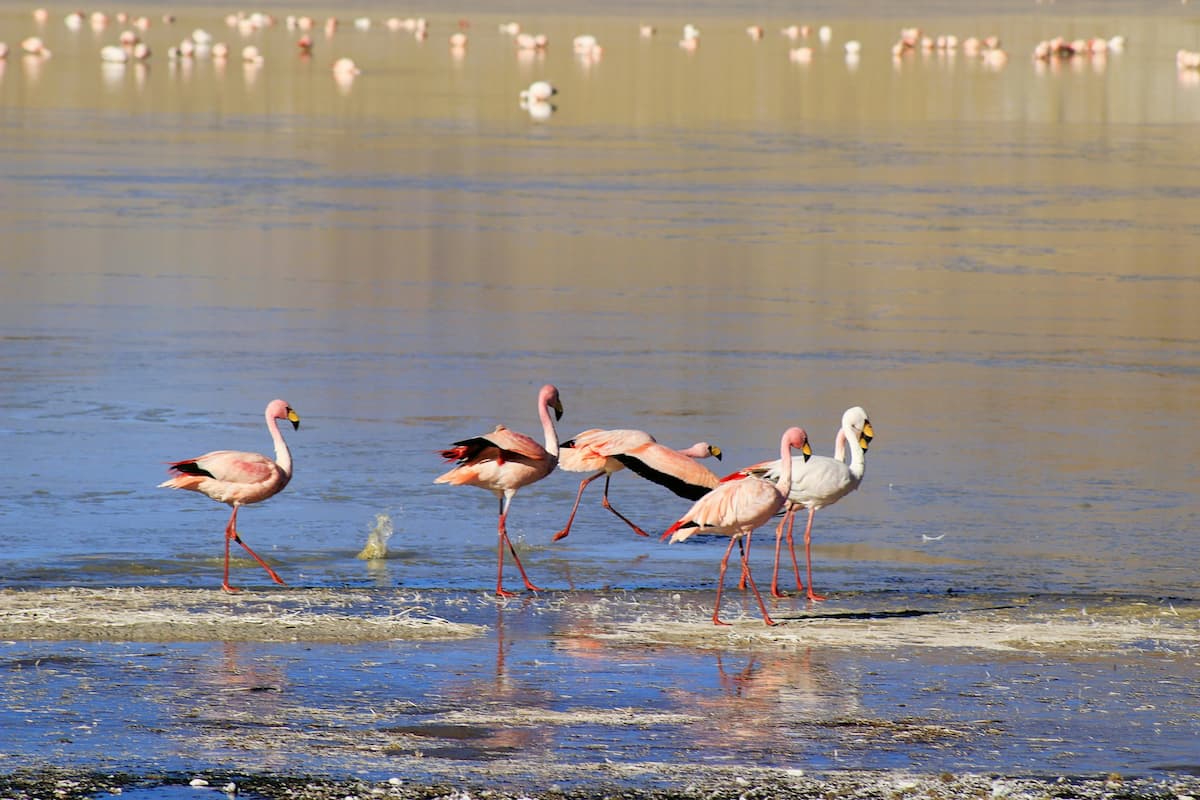
This little spot is a quick stop if you decide to brave the drive to El Tatio by yourself. True to its name, the lake is full of flamingoes that are chowing down on brine shrimp.

I’d recommend stopping on the way back to San Pedro, given you need to get to El Tatio before the sun even rises!
Hours
24/7
Tickets
None—just pull over on the road’s wide shoulder to see several different species of flamingoes.
How to get there
As mentioned above in the El Tatio section, I really wouldn’t recommend driving here on your own. In our experience, the road was absolutely horrific (at least when we visited) and I seriously can’t imagine trying to drive it in the dark.
That being said, if you have a 4WD and high clearance car and an adventurous spirit, you’ll find the lake right along the road you’ll take to El Tatio.
Alternatively, most of the El Tatio tours will stop here as well, like this seven hour option or this shorter option.
7. Soak in the Puritama Hot Springs
If you follow our adventures on YouTube or Instagram, you probably know how much we love hot springs. And the Puritama Hot Springs are definitely some of our favorites—a lush series of pools with crystal clear waters, connected by waterfalls and in the middle of a desert. It’s one of the most relaxing things to do in San Pedro de Atacama, plus it’s ABSOLUTELY stunning—there are so many fireflies flitting through the waterfalls’ mist and along the water.
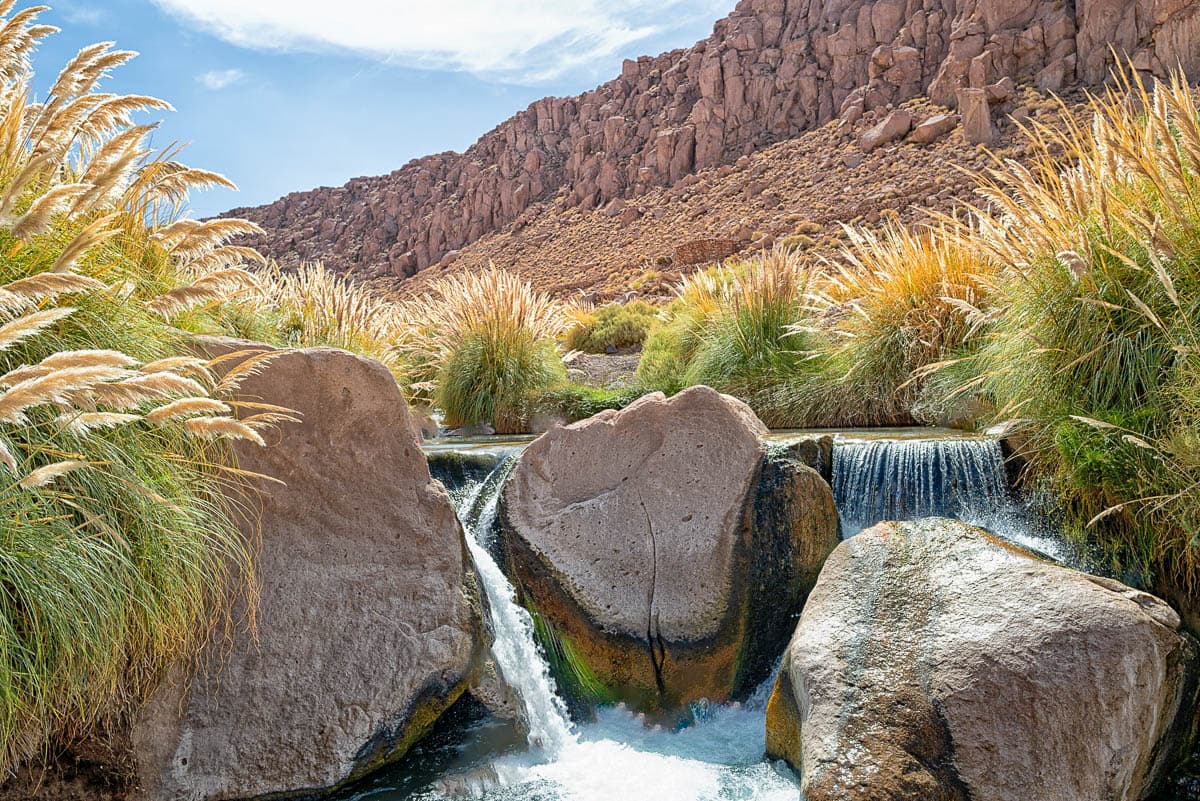
The springs are on the more rustic side, with limited facilities beyond bathrooms and changing rooms for each gender. And the water is warm, as opposed to being piping hot. But it seriously feels so refreshing after spending a day or two hiking around one of the driest deserts on the planet.
Hours
9:30 AM to 6 PM daily
Tickets
Tickets are 35,000 CLP per person. Tickets must be purchased online ahead of time and are available for two different slots—either 9:30 AM to 1:30 PM or 2:30 PM to 6 PM every day. It’s not unusual for the tickets to sell out, so I’d recommend purchasing tickets at least a few days in advance.
How to get there
The hot springs are about 35 minutes north of San Pedro de Atacama and are just a small detour if you’re already driving to El Tatio.

Not to beat a dead horse, but I really wouldn’t recommend driving to El Tatio geysers yourself. Still, if you’re only driving to the hot springs, the roads leading here are less awful than the ones leading to the geysers. You’ll still need to drive slowly and carefully though!
If you’d prefer to go as part of a group, there’s a few options, like this tour that includes your entry fee or this transfer-only option.
8. Drive the Valle del Arcoiris
If you’re looking for one of the more off-the-beaten path things to do in San Pedro de Atacama, I’d suggest heading to the aptly named Valle del Arcoiris (or Rainbow Valley).
Here, minerals, like iron, sulfur, and gypsum, cause the mountains to be painted in vibrant colors, with shades of green, red, white, and brown streaked along their slopes. And, beyond the colorful mountains, there are so many unique rock formations here—spires, canyons, plateaus—it feels like you’re transported to a whole different planet.

There are three different roads for you to drive or walk down (one of which I’d only recommend driving down with a high clearance, 4WD car) and take in the incredible surrounding scenery.
Hours
8:30 AM to 6 PM
Tickets
Entry is 10,000 CLP, cash only.
How to get there
Valle de Arcoiris is located about an hour north of San Pedro de Atacama. Depending on the time of the year, you may need a high clearance 4WD vehicle to get there, as small rivers can form on the roads during rainier periods (typically December through March).

Alternatively, you can join a tour, like this six hour option, which will take care of any fording of rivers for you and stop at Yerbas Buenas petroglyphs of vicuñas and Andean foxes, which date back over 10,000 years!
9. Walk to Piedras Rojas
Piedras Rojas is a series of massive red and pink boulders that line the shores of a salt lagoon and are surrounded by towering mountains and volcanoes.
There’s a 2.9 km flat trail that winds from the parking lot to the banks of Piedras Rojas, where you can enjoy the dramatic landscape and get an up close and personal look at the salt lake, which has a unique emerald green hue.
If you come on a particularly calm day, there’s certain areas of the lagoon that perfectly reflects the surrounding mountains. It’s absolutely gorgeous!

This lake sits at 4,200 meters above sea level, so, even though the trail is quite easy, you might be a bit out of breath while you do it. Additionally, be sure to bring warm layers to throw on here. I made the incredibly unwise decision of wearing shorts here and was absolutely freezing during our walk.
Hours
8 AM to 6 PM
Tickets
Purchasing entry to Piedras Rojas and the neighboring Altiplano lagoons (more on that below) is a bit trickier than just driving up to a gate and buying your tickets.
We actually wrote a whole article about visiting Piedras Rojas, but here’s everything you need to know in a nutshell.
First of all, you need to purchase your timed entry ticket online beforehand. You can either purchase entry to only one of the sites or, alternatively, purchase tickets for them both together (in which case, you’ll need to also pick which one you want to visit first). Entry for one of the sites is 10,000 CLP, while entry to both sites is 15,000 CLP. I’d recommend going to both of the sites, as they’re located pretty close together and offer different benefits.

Tickets here sell out ahead of time, especially for Piedras Rojas, so I’d recommend purchasing tickets at least a few days in advance. It’s also worth noting that the site is super finicky, often timing out before you can make a purchase or declining foreign credit cards, so be prepared for a frustrating experience!
On the day of your visit, you’ll need to drive from San Pedro de Atacama to the control office in the town of Socaire an hour before your timed entry (e.g., if your ticket is for 8:30 AM, you’ll need to get to the control office by 7:30 AM at the latest) or risk forfeiting your ticket.
Here, you’ll need to show your confirmation email to an attendant, who will then give you a ticket to the site. I’d recommend downloading or taking a screenshot of the email ahead of time, as I didn’t have cell service here.

Each of the sites is about an hour past this control office, where a ranger will check your entry ticket before letting you park.
How to get there
Piedras Rojas is located here, right outside the Los Flamencos National Reserve, about an hour and 45 minutes south of San Pedro de Atacama. The roads here are decently maintained, so, if you have your own rental car, I’d recommend just driving here yourself.

However, if you have difficulty purchasing the tickets online or don’t have your own vehicle, there are tours that you can take to get here, like this option or this option, both of which stop at Piedras Rojas AND Lagunas Altiplánicas, as well as the Chaxa Lagoon, which is a great place to spot flamingoes.
10. Visit Lagunas Altiplánicas
Lagunas Altiplánicas are two lagoons, Miscanti and Miñiques, with beautiful deep blue waters, that sit at the base of Cerro Miñiques volcano. You can usually walk between the two lakes on a flat and easy pathway, although, for the last few years, a portion of the pathway around Laguna Miñiques has been closed for renovations.

We wrote a whole article about Lagunas Miscanti and Miñiques if you’re interested in visiting, but, in a nutshell, our favorite thing about this spot is the abundant wildlife that lives along the lagoons’ shores. We spotted flamingoes and a TON of vicuñas here.
Hours
8 AM to 6 PM
Tickets
See the explanation above for Piedras Rojas.

How to get there
See the explanation above for Piedras Rojas.
11. Take a photo of the Tropic of Capricorn sign
As you’re driving to and from Lagunas Altiplánicas and Piedras Rojas, you’ll notice a conspicuous sign for “Tropico de Capricornio” or the Tropic of Capricorn.
If you’re like me and had no idea what the Tropic of Capricorn actually is, it’s the southernmost point where the sun’s rays can be seen directly overhead at local noon, which defines the boundary between the Earth’s Southern Temperate Zone from the tropics. This line was incredibly important to the early explorers, like Magellan and Captain Cook, who used these imaginary lines for navigational purposes.

Even if you’re not into old time-y explorers, it’s still pretty neat to be able to straddle one of the five main lines of latitude on the planet! Just be careful as you will be on the side of a busy highway.
Hours
24/7
Tickets
Free—just pull over!
How to get there
The sign is located here and, as noted above, is en route to some of the popular things to do near San Pedro de Atacama, like Piedras Rojas, Lagunas Altiplánicas, or Laguna Chaxa.
12. See flamingoes at Laguna Chaxa
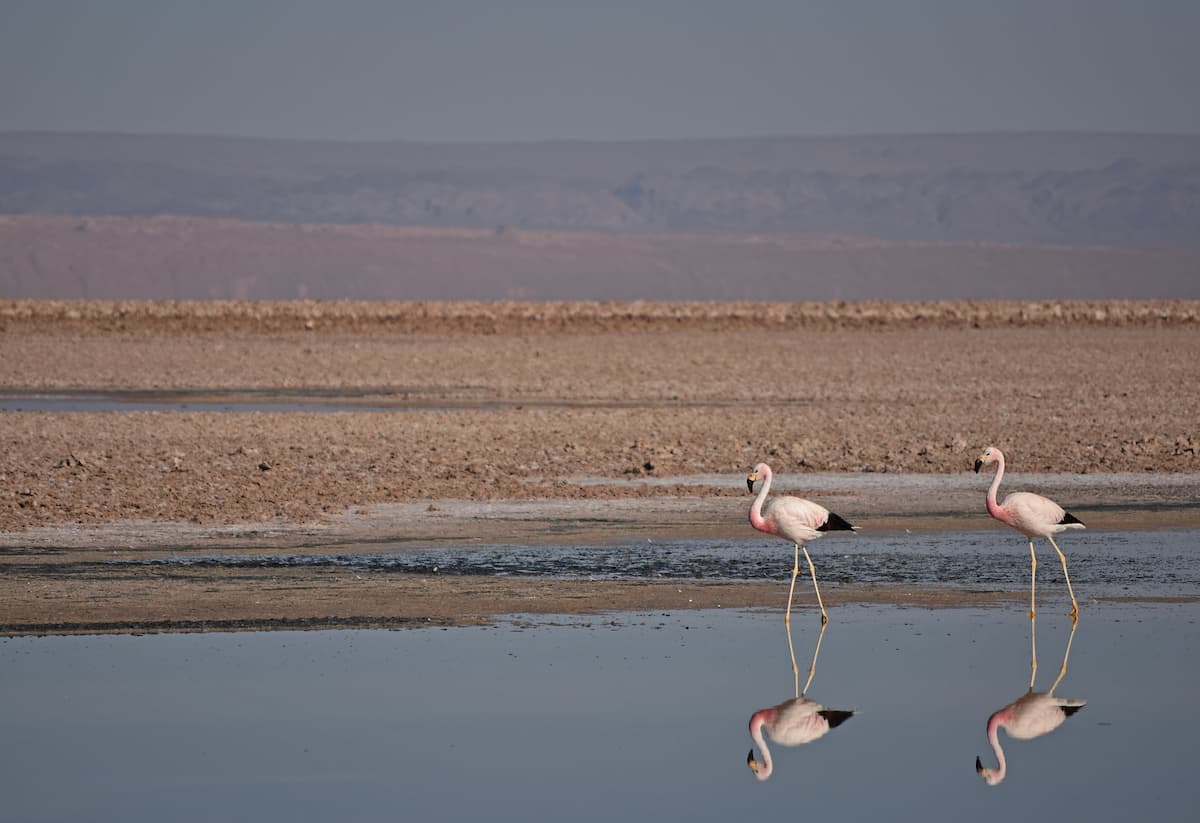
Located in Los Flamencos National Reserve, Laguna Chaxa is a brackish lake that’s known for its beautiful reflections of the surrounding mountains and for being one of the best places near San Pedro de Atacama to see flamingoes. There’s actually three species of flamingoes that call Laguna Chaxa home—Chilean, Andean, and James flamingoes.

There’s a nice little walking path around the lake to do some bird watching, with educational signs along the way and a small visitor’s center, with information about the lagoon and the flamingoes. This is also an incredible place to watch the sunset.
Hours
7 AM to 6 PM
Tickets
Tickets are 13,714 CLP, which can be purchased online or in person.
How to get there
If you’re driving there yourself, be sure to put this Laguna Chaxa in your GPS. There’s another Laguna Chaxa listed on Google Maps in the same vicinity that will lead you down a road with a closed gate—I sadly know from personal experience!
Alternatively, Laguna Chaxa is located along the route to Piedras Rojas and Lagunas Altiplánicas and, accordingly, is included in most tours there, like this option or this option.
13. Go stargazing
One of the most popular things to do in San Pedro de Atacama is to simply gaze up at the night sky. The Atacama Desert is said to be one of the best places on the planet to see the Milky Way, stars, and other planets, due to its high elevation, dry atmosphere, limited light and radio pollution, and clear skies.

You can simply drive a bit outside of San Pedro de Atacama to get away from the small town’s light pollution and, once night falls, enjoy the stars by yourself. Alternatively, you can go with a knowledgeable guide to learn more about the celestial bodies above, like this tour that takes you to a lodge where you can enjoy the starry night above with two telescopes, all while drinking a complimentary glass of wine!
14. Wander around San Pedro de Atacama
Of course, while you’re visiting San Pedro de Atacama, you might as well explore the town itself, right?
The downtown area consists of a few dusty streets with bars, restaurants, travel agencies, currency exchanges, and souvenir shops. The main drag, Caracoles, is pedestrian only and fun to mosey around for an hour or two, just people watching and scoping out the best happy hour deals.

I wouldn’t say that San Pedro is exactly a culinary beacon, but we did find a few restaurants that we enjoyed, including Emporio Andino, with yummy empanadas and pastries, and Rincon de Sal, which had tasty veggie burgers and a solid happy hour special.
Many of the restaurants and bars in San Pedro de Atacama have kind of funky hours, oftentimes closing for several hours in the afternoon and earlier in the evening than I would expect for a touristy town.

So if you have your heart set on visiting a particular place, I’d recommend double checking the hours and popping by earlier on in your trip—it’s not unusual for places to not be open when they’re supposed to be.
15. Climb Cerro Toco
If you’re looking to include something more adventurous in your Chile itinerary, consider conquering Cerro Toco, a volcano whose summit offers expansive views of the surrounding volcanoes and the sweeping Atacama Desert.
The trail is on the more challenging side to begin with, steeply gaining almost 1,500 feet in elevation in about 1.3 miles (one-way). But, more importantly, you’ll be starting at a VERY high altitude—over 16,600 feet over sea level and obviously, climbing even higher (actually, well over the altitude of both of the base camps for Mount Everest)! Accordingly, acclimating for a few days in San Pedro de Atacama before tackling this trail is incredibly important.

You’ll be hiking to over 18,000 feet of elevation, so remember to bring lots of warm layers. It ges COLD at the summit!
Hours
Technically open 24/7, but, due to the extreme elevation, I personally wouldn’t recommend going hiking before sunrise or after sunset, so you’re more likely to run into other hikers in the event you experience severe altitude sickness.
Tickets
None
How to get there
As far as I can tell, you’re not technically required to have a guide on Cerro Toco, so you could theoretically drive to the trailhead and attempt the hike by yourself.However, I really wouldn’t recommend going by yourself, unless you have a LOT of experience with high altitude hiking and have appropriately acclimated to the Atacama Desert’s altitude.

If you’ve never hiked at such a high altitude before, I’d strongly recommend going with a guide, who can help out in the event you experience altitude sickness along the trail (which can have serious consequences, including death, if untreated). The guides on this tour will make sure that everyone in your group is properly acclimated and going a comfortable speed, while still leaving plenty of time to enjoy views from the summit of Cerro Toco.
16. Get a photo with the Hand of the Desert
If you’re going to be in the Atacama Desert for a while, you can consider making the trek to the Hand of the Desert, a sculpture of an enormous hand reaching out of the barren desert landscape below.

In full transparency, there’s not much to do here, other than to take some interesting photos of the sculpture and the surrounding landscape. If you’re into photography, I’d suggest trying to stay here until nightfall, when the spectacular night sky twinkles to life here. The Milky Way directly above the sculpture makes for some very cool photos!
Hours
Open 24/7
Tickets
None
How to get there
The only way to get to the Hand of the Desert is by making the four hour drive southwest of San Pedro de Atacama.
It’s in the middle of nowhere so you REALLY have to want to go see it. Still, if you’ve got time to kill or are really into photography, it’s definitely a unique experience in the Atacama Desert!
17. Head to the Salar de Uyuni
While most people think of the Atacama Desert primarily being in Chile, it actually stretches up through the south of Bolivia, with some of its most dramatic sand dunes, geysers, hot springs, and mountains being found just north of the Chilean border.

I thought the Atacama Desert in Chile was spectacularly beautiful, but the landscapes in southern Bolivia absolutely blew me away—it’s definitely some of the most otherworldly landscapes on the planet.
Beyond the Atacama Desert, you’ll also find Salar de Uyuni (i.e., the Uyuni Salt Flats), a massive area that sprawls over 4,000 square miles and can be seen from the International Space Station. This area has a whole host of impressive superlatives—the largest salt flats, the flattest place, and, when the flats flood in the rainy spring, the largest mirror on the planet.
Unlike the Atacama Desert in Chile, there aren’t really maintained or even established roads through much of the Bolivian side, so I generally wouldn’t recommend heading here by yourself. We went on a tour through the Salar de Uyuni and the Bolivian side of the Atacama Desert with a company that had two Land Cruisers from the 1980s that zoomed through fields of alpacas, bashed through dunes, and generally, drove on terrain that I would be WAY too scared to do.

There are so many incredible things to do in Uyuni, from exploring the aforementioned largest salt flats to spotting flamingoes in colorful salt lagoons. Thankfully, there are several tons of Uyuni Salt Flats tours that head from San Pedro de Atacama to Uyuni that will take care of all of the crazy dune bashing and fixing of vehicle breakdowns for you, like this four day option or this three day option.
How to get to San Pedro de Atacama, Chile
San Pedro de Atacama is kind of located in the middle of nowhere, in the sprawling expanse of the Atacama Desert.
To reach this small city, you’ll need to fly into El Loa Airport in the city of Calama, which is a little over an hour away from San Pedro de Atacama. El Loa is a domestic airport, so most travelers, including us, will need to fly into Santiago first and then connect to Calama.

Out of all of the cities we visited in our seven months living in South America, Calama was one of the cities where we felt the most unsafe, so I personally wouldn’t recommend hanging around here for too long.
From here, you can either rent a car and drive to San Pedro yourself or, alternatively, book a transfer to the city, like this shared option or this transfer, which has shared or private options.
Should you get a rental car or go on tours around San Pedro de Atacama?
If you’re headed to San Pedro de Atacama, you’re probably wrestling with the question—should we get a rental car?
Justin and I wrestled with answering this question and, after pricing out the two options, we opted to rent a car. The freedom and flexibility of having a rental car was great, but, to be honest, I’m not totally sure I would’ve made the same choice again.

Driving around San Pedro de Atacama can definitely be on the sketchier side—the roads are full of potholes and stabby rocks that are just waiting to pop your tires, with the only gas station in a 90 kilometer radius being located in San Pedro de Atacama.
If you have car trouble somewhere, there’s no cell service outside of town and it’s not unusual to not see anyone else on the road for really long stretches of time. And the weather here is extreme, with the days becoming super hot and dry and the nights dropping into freezing temperatures.

If you do decide to get your own rental car, you need to proactively take safety precautions—fill up with gas and check your tire pressue every time you leave San Pedro, have tons of extra water and snacks in the car, and it wouldn’t be a terrible idea to have a satellite phone on hand, just in case.
If you’re not particularly handy in the event of an automotive emergency, I’d recommend just going on organized tours instead, to be on the safe side.
Where to stay in San Pedro de Atacama
Although San Pedro de Atacama is a tiny town, it definitely is well set-up for tourists, with plenty of restaurants, bars, and hotels to choose from.
Hostal Mama Tierra
If you’re looking for a more budget-friendly stay in an excellent location, this hostel has a mix of dorm and private rooms, all in a clean and cozy home. There’s a solid breakfast buffet included every morning and the friendly staff are happy to help with any questions you might have during your stay.

Ckoi Atacama Lodge
For something a bit more upscale, this lodge is beautifully decorated and comes with some bougier touches, like a pool, resident alpacas, and a firepit to cozy up to at night. The complimentary breakfast is seriously SO good (with homemade pastries!) and the whole hotel has a very relaxed and welcoming vibe.
Terrantai Lodge Hotel
This hotel is definitely one of the bougiest options in San Pedro de Atacama, in a beautiful historic home. There’s lots of cool features of staying here—a communal dining space that hosts complimentary breakfast in the morning and wine tastings (for two hours!) in the evenings, a pool to cool down in, and a fire pit to warm up at night. The rooms are on the cozier side, but have enormous beds and lovely views of the surrounding garden.

When to Visit San Pedro de Atacama
The most popular time to visit San Pedro is in the summer, from December through February, when the temperatures are warmer and the skies tend to be clear (perfect for stargazing!).
This is also the busiest—and, accordingly, the most expensive—time to visit. For what it’s worth, though, we visited in February and didn’t find the town or any of the surrounding attractions to be overly crowded.

The shoulder seasons of the springtime, from September to November, and the fall, from March to May, are also solid options. You have a higher chance of encountering cloudier skies during this period of time, but cooler days, lower prices, and fewer crowds.
I generally wouldn’t recommend visiting in the wintertime, from around June through August, as the temperatures can be uncomfortably chilly and some of the things to do in San Pedro may have more limited hours or even be closed during this period of time.
There are so many incredible things to do in San Pedro de Atacama, Chile and in the surrounding desert—it’s one of the most otherworldly places I’ve ever visited! Do you have any questions about exploring the Atacama Desert? Let us know in the comments below!
