

The Atacama Desert is one of the most popular destinations in Chile—and for good reason! This beautiful region—which has lots of impressive titles, like the driest non-polar desert and one of the oldest deserts on the planet—has a lot of incredible places to explore, including Lagunas Miscanti and Miñiques.
These lakes are renowned for their natural beauty, thanks to their dark blue waters and the neighboring volcanoes, and, more importantly, the abundant wildlife that hangs out on its shores. If you want to add these lakes to your Atacama Desert itinerary, here’s everything you need to know about visiting Lagunas Miscanti and Miñiques, including how to get there and some tips to make the most of your visit.

This post may contain affiliate links. If you make a purchase through them, we may receive a small commission, for which we are extremely grateful, at no extra cost to you.
What are Lagunas Miscanti and Miñiques?
Lagunas Miscanti and Miñiques, sometimes collectively called Lagunas Altiplánicas (or the Altiplanic Lagoons), are two brackish water lakes. These two lakes were actually initially one enormous body of water, created by a fault line, until a lava flow from a nearby volcano separated them.
The lakes are stunning, with brilliant blue water rimmed by salt-encrusted shores, and surrounded by the towering Cerro Miñiques volcano and Cerro Miscanti. However, the biggest draw to them is the plethora of wildlife that you can see along its shoreline, including vicuñas, culpeo foxes, flamingos, and horned taguas. When my husband, Justin, and I visited, we saw several flamingoes and DOZENS of vicuñas.

There’s a walking path that leads along their shores, connecting the two lakes. When we visited in early 2025, much of the trail around Laguna Miñiques was closed, but you can still walk along the shores of Laguna Miscanti and drive between the two lakes to enjoy them both.
How to get to Lagunas Miscanti and Miñiques
The lagoons are located here, right outside of Los Flamencos National Reserve. Lagunas Miscanti and Miñiques are about 120 kilometers south of San Pedro de Atacama, the main town that visitors stay in when exploring the Atacama Desert. You can either head to them from San Pedro de Atacama by yourself or go there with a tour group.
Visiting Lagunas Miscanti and Miñiques by yourself
If you have a rental car, you can just drive to the lagoons yourself. Unlike a lot of roads around San Pedro de Atacama, these roads are pretty well-maintained and drivable with any kind of vehicle.

However, it’s a little bit more complicated than simply just driving up to Lagunas Miscanti and Miñiques.
Getting tickets
In order to visit the lagoons, you’ll need to purchase a timed entry ticket online ahead of time, as no tickets are sold in person.
You can either just purchase tickets for Lagunas Miscanti and Miñiques or you can add on Piedras Rojas, a nearby series of massive red and pink boulders lining an emerald hued lagoon. Entry to one of the sites is 10,000 CLP per foreign adult, whereas entry for both of the sites is 15,000 CLP.

We’ve written a whole post about Piedras Rojas, but, in short, I’d definitely recommend visiting both while you’re in the area—the scenery around Piedras Rojas is absolutely stunning, whereas Lagunas Miscanti and Miñiques is a much better place to see wildlife.
If you opt to hit both of these sites, you’ll need to purchase a combination ticket, which specifies which one you’ll hit first. Piedras Rojas is actually one of the most popular things to do near San Pedro de Atacama, so I’d recommend heading there first thing in the morning to minimize the crowds and then heading to the two lagoons once you’re done there (i.e., on the website, be sure to select the “First the southern hot water salt flats ‘Piedras Rojas’ + Second, the Miscanti and Miniques Lagoons” option).

Time slots to visit these sites, especially Piedras Rojas, can sell out, so I’d recommend purchasing your tickets at least a few days in advance.
It’s worth mentioning that the website can be super buggy—it’s a common complaint that it times out or fails to process foreign credit cards. You can reach out here if you have issues with the website or, if you run into too many troubles, you can always opt to take a tour instead, where the operator will handle the purchasing of the tickets for you.
Picking up your tickets
On the day of your visit, you’ll drive to this office in the small town of Sociare, which is about an hour away from San Pedro de Atacama, to pick up your physical ticket.

You need to be at the office one hour before your timed entry ticket starts (e.g., if your timed entry ticket for Piedras Rojas starts at 8:30 AM, you’ll need to get to the office no later than 7:30 AM to pick up your ticket). If you arrive too far outside of your window, they may elect to not issue you your ticket, as parking can be pretty tight with the allotted visitors.
I’d recommend taking a screenshot of your ticket purchase confirmation email, including the QR code they send you, when you’re back in San Pedro de Atacama, as there’s no cell service in Socaire. You’ll need to show this QR code and share your license plate information to receive your ticket.
Driving to Lagunas Miscanti and Miñiques
Once you’ve got your physical ticket, you can drive to either Piedras Rojas, which is located here, or the lagoons, whichever one you’ve purchased tickets to see first.

If you drive to Piedras Rojas first, be sure to keep an eye out on your left hand side for Volcán Miñiques, which is actually a series of four overlapping volcanoes that tower over 13,500 feet high. This is also a great place to spot vicuñas!
Visiting Lagunas Miscanti and Miñiques with a tour
If you don’t have a rental car or don’t want to bother with the logistics of the complicated ticket process outlined above, you can, instead, opt to go on a tour, where they will take care of transportation, tickets, and meals while you’re out exploring.

Most tours, like this option and this option, are all day and include visiting lots of stops around Lagunas Miscanti and Miñiques, including Piedras Rojas and Laguna Chaxa, which is one of the best places in the Atacama Desert to see flamingoes.
Exploring Lagunas Miscanti and Miñiques
Before you reach the Altiplanic Lagoons, you’ll reach a closed gate, where an attendant will check your ticket and instruct you where to park, typically starting with the much larger and heart-shaped Laguna Miscanti.
There used to be a 1.5 mile long walking trail (one-way) that led down to the shores of Laguna Miscanti and over to Laguna Miñiques. However, for the past few years, the only part of the trail that’s been open has been down to the shores of Laguna Miscanti, with the other areas of the trail closed off for renovation (let us know in the comments below, if you visit, if the trail is reopened or not!).
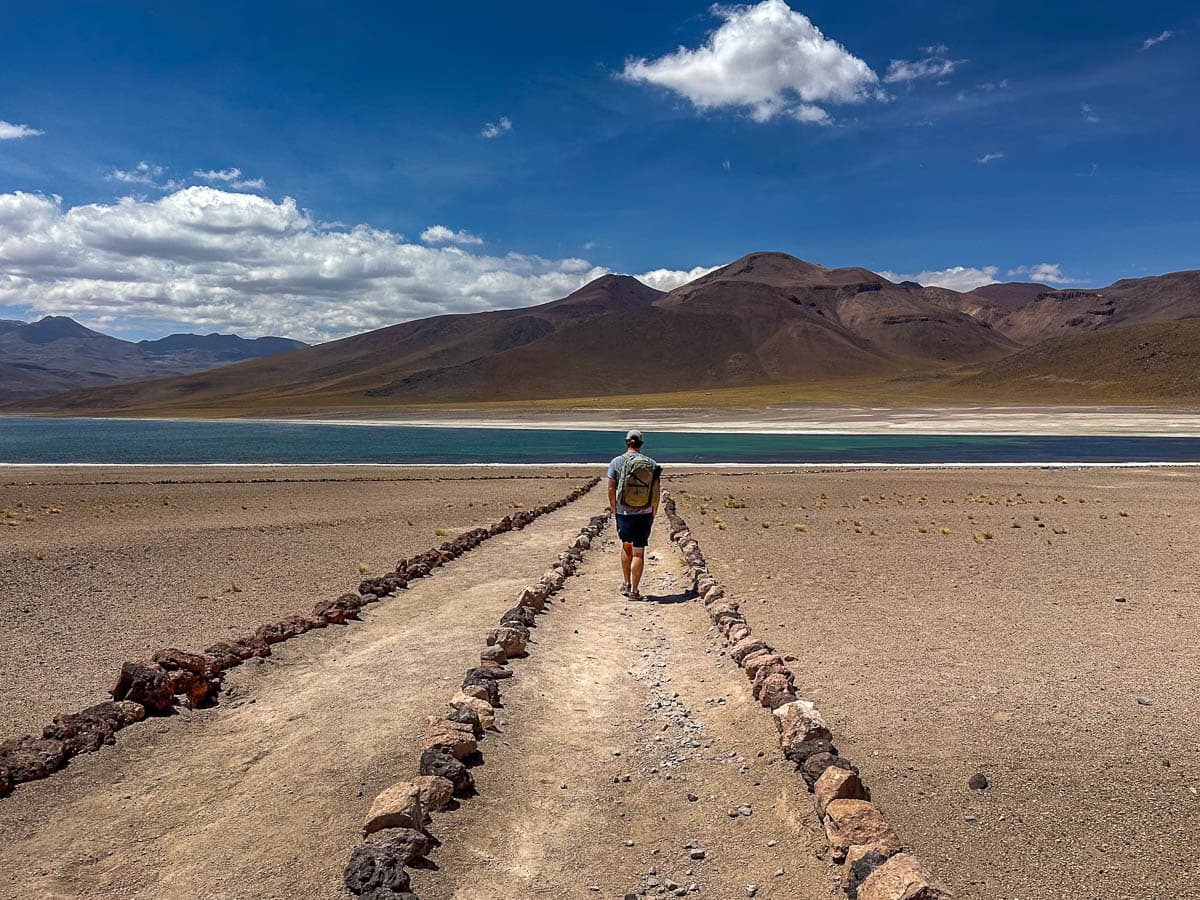
Accordingly, you can walk down near the shores of Laguna Miscanti along its walking path. The path is generally pretty flat, but don’t be surprised if it’s a bit challenging to walk here—the Altiplanic Lagoons are located over 13,500 feet above sea level, so you definitely have to work harder here!
Despite the extra exertion, the walk near Laguna Miscanti’s shores is definitely worth it to take in the views of the lake’s vibrantly hued waters and the surrounding landscape, plus see if you can spot any wildlife on the trail. When we visited, there were a few flamingoes feeding near the shoreline.
Once you’re done here, you can drive (or walk over, if the path is reopened) the two kilometers over to Laguna Miñiques, which had a TON more wildlife than Laguna Miscanti when we visited. We saw several flamingoes and DOZENS of vicuñas near the shoreline.

It’s worth mentioning that, at either lake, you can’t really get very close to the shoreline to protect their fragile ecosystems, so don’t plan on swimming in or drinking from the lakes (although I don’t think they would taste very good anyway!). And, for the best wildlife viewing, I’d strongly recommend bringing along binoculars. We had our telephoto lens on our Sony a7iii, which I used for getting a closer look at (and, obviously, lots of photos of!) wildlife, but I honestly wish I had something with even a stronger magnification ability!
What to wear to Lagunas Miscanti and Miñiques
Regardless of when you visit Lagunas Miscanti and Miñiques, I’d recommend bringing along plenty of warm layers. While the Atacama Desert can get scorching hot during the day in the summertime, the temperatures regularly drop below freezing at night and can stay surprisingly chilly during the day in the colder months.
Justin and I visited the Altiplanic Lagoons in February, which is one of the warmest months in the Atacama Desert, and I foolishly wore shorts and a t-shirt. This was a HUGE mistake—I was absolutely freezing during our early morning visit.

So, instead, if you’re visiting in the summer months, I’d recommend wearing something light and breezy as a base layer and bringing along some warmer outer layers (like a puffer jacket kinda warm) to throw on over it. And, if you’re visiting in the cooler months (June, July, and August), I’d recommend bringing along even warmer clothes—it regularly doesn’t get above the mid-50s here!
It’s generally not necessary to wear hiking boots, as the walking trails here are along flat, gravel pathways. We each wore our beloved hiking sandals (his and hers), which worked perfectly. But I would recommend wearing comfortable walking shoes (this is not the place to bust out your best stilettos!) and wearing something with decent traction and support, especially if you’re visiting in the wintertime, in case you run into any ice or snow along the trail.
Things to do near Lagunas Miscanti and Miñiques
While you’re out exploring the Altiplanic Lagoons, I’d recommend stopping by some of the other cool attractions in the area.
Visit Piedras Rojas
As mentioned above, Piedras Rojas, located here, is in the same natural reserve as Lagunas Miscanti and Miñiques, about 45 minutes past the lakes.

There’s a short walking path that you can take around this area, whose ground is lined with massive red and pink boulders that are surrounded by a salt lagoon, with emerald green water, and, beyond, the Andes Mountains and a series of volcanoes. It’s one of the most beautiful and dramatic sites to include on your Atacama Desert itinerary and well worth a stop while you’re in the area.
Stop for a bite in Socaire
The town of Socaire, where you need to stop to pick up your ticket to the Altiplanic Lagoons or Piedras Rojas, is pretty tiny and doesn’t have a ton going on. But, if you are going to explore the area that’s southeast of San Pedro de Atacama, it is definitely the best place to grab lunch or snacks.
If you want a full blown meal, I’d suggest stopping at Cocineria San Santiago or Cocineria Comunidad De Socaire. Alternatively, if you’re just looking for a coffee or a quick empanada to enjoy on the road, we had a good experience when we stopped in the Cocinería y Cafetería San Antonio for some caffeine after our time exploring the lagoons.
See flamingoes at Laguna Chaxa
Laguna Chaxa is a salt lagoon that’s located in the Salar de Atacama, the largest salt flat in Chile. While the brackish lake is known for its waters’ beautiful reflections of the surrounding mountains, its biggest claim to fame is the fact that several species of flamingoes call the lagoon home.

There’s a nice little walking path around the lake to enjoy watching the flamingoes, as well as a small visitors center where you can learn more about the birds and the surrounding landscape. If you can swing it, I highly recommend trying to visit here at sunset—it’s absolutely stunning!
If you’re driving yourself, just be sure to put this Laguna Chaxa into your GPS to make sure you wind up at the right spot. I can attest, from personal experience, that there’s another Laguna Chaxa on Google Maps in the same vicinity that will take you down a gnarly road that’s closed off with a gate—can confirm that seeing cute flamingoes is much more fun!
Get a photo with the Tropic of Capricorn sign
As you’re driving from San Pedro de Atacama to Lagunas Miscanti and Miñiques, you’ll pass this massive sign for “Tropico de Capricornio” or the Tropic of Capricorn.
If you’re not up to snuff on your old time-y navigational terms, the Tropic of Capricorn is one of five major latitudinal lines on Earth (in addition to the Arctic and Antarctic Circle, as well as the Equator and the Tropic of Cancer), which were used by early explorers for navigation. The Tropic of Capricorn is essentially the southernmost point on the planet where the sun is directly overhead at local noon. This line is definitely not as important in the modern era of GPS, but was SUPER important to the early explorers, like Magellan.

Even if you don’t care too much about random latitudinal lines on the planet, it’s still a neat spot to get a photo to remember your time in the driest non-polar desert on the planet.
Enjoy your time at the lagoons—I hope your visit is full of adorable flamingoes and vicuñas! Do you have any questions about visiting this beautiful area of the Atacama Desert? Let us know in the comments below!
