

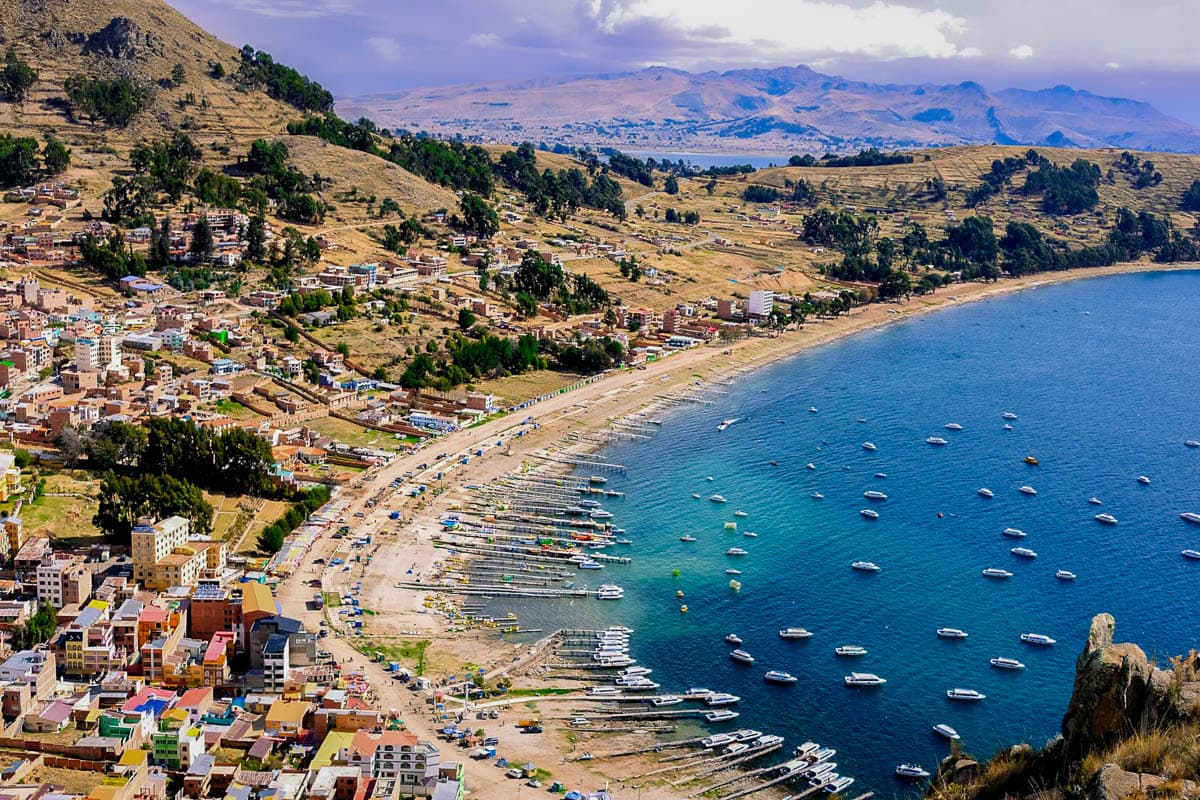
If you’re traveling through Peru and Bolivia, there’s a good chance you’ll be stopping in Copacabana, Bolivia, a small town on the shores of Lake Titicaca, the largest navigable lake in South America. This sleepy, little town has a lot of charm—but what’s there to do and see here? My husband, Justin, and I spent a week in Copacabana, Bolivia and are breaking down everything you need to know to enjoy your time here.

This post may contain affiliate links. If you make a purchase through them, we may receive a small commission, for which we are extremely grateful, at no extra cost to you.
How to get to Copacabana, Bolivia
There’s a few ways to get to Copacabana, although almost always, you’re going to be using a bus in some capacity to get here.
Flying
Copacabana has a small airport, but, from poking around Google Flights, it does not appear there are regular flights from any city here.

Instead, you’d need to fly into one of the closest airports:
- El Alto International Airport in La Paz, Bolivia, which is a little over three hours away. From the airport, you’d need to take a taxi to the bus station in La Paz and, from there, grab a bus to Copacabana.
- Inca Manco Capac International Airport in the city of Juliaca, Peru, which is three and a half hours away. From the airport, you can take a taxi or a shuttle, like this option or this option, to the bus station in the nearby city of Puno, where you can catch a bus the rest of the way to Copacabana.
Bus
Let’s be honest—it’s unlikely you’re flying to Bolivia just to visit Copacabana.
While the town is definitely worth exploring, most travelers, including myself, typically include Copacabana on their Bolivia itinerary as they’re coming and going from other places. For example, we stopped here after visiting the Uros islands in Puno, Peru and were making our way down to the city of La Paz.
Accordingly, there’s a good chance you’ll be catching a bus here from some other destination in either Peru or Bolivia. We traveled all over South America, almost exclusively by buses, and found it an affordable, easy, and usually, quite comfortable way to zip around.

Here are some of the most popular cities that are easy to bus to Copacabana:
- La Paz, Bolivia to Copacabana (4 hours away)
- Puno, Peru to Copacabana (4 hours away)
- Cusco, Peru to Copacabana (11 hours away)
- Arequipa, Peru to Copacabana (11 hours away)
Visas to get into Bolivia
If you’re from the United States, like us, and a handful of other countries in the Caribbean or Africa, there is a fairly complicated and expensive tourist visa process to get into Bolivia. You can check your country’s requirements here.
In addition to showing our passports, we needed to have printed copies of our current bank statements, an itinerary of where we were staying while we were in Bolivia, our departing flight confirmation, yellow fever vaccine card, and two passport-sized photos. Additionally, each of our tourist visas cost $160 USD, which can be paid by local currency or card.
Be sure to have some cash on hand. If you’re crossing into Bolivia from Peru, like we did, there was a cash-only print and copy shop at the border that we used to make extra copies of documents we needed. Even if you’re totally prepared with all of the required documents, the border agent still had us make copies of our visa applications that were filled out on the spot—so having extra cash is a must!
It honestly was a pretty stressful and time-consuming process, so, if you can, I’d strongly suggest trying to head to a Bolivian embassy or consulate before your trip to secure a tourist visa there ahead of your visit.
If you do get a visa on arrival, be sure to take your bags with you into the Bolivian immigration office. Our bus left without us, because the visa process was taking so long, so we may have just lost our luggage if we didn’t happen to bring it with us!
Things to do in Copacabana, Bolivia
Copacabana is a pretty small and sleepy town, so, in full transparency, there isn’t a TON to do here.

However, if you’re looking to have a relaxing few days on Lake Titicaca (I personally much preferred staying in Copacabana over Puno, Peru, the other major town visitors stay in to explore Lake Titicaca) and immerse yourself in a place with authentic Bolivian culture, there’s no better spot. Here are a few of the best things to do in Copacabana.
1. Visit Isla del Sol
The most popular thing to do in Copacabana is to visit Isla del Sol.
This island, located about a one and a half hour boat ride from town, is considered by many to be the birthplace of the Inca civilization. Specifically, it’s believed that the Inca sun god, Inti, and the first Inca couple, Manco Cápac and Mama Ocllo, were born on this island.

Today, you can explore ancient Inca ruins on Isla del Sol, including the Temple of the Sun or the Sacred Rock where Manco Cápac and Mama Ocllo were allegedly created, as well as enjoy spectacular views of Lake Titicaca and the surrounding snow-capped mountains. Additionally, there are around 3,000 Indigenous people who live, farm, and fish on the island, making this an excellent place to experience what life is like on Lake Titicaca.
The cheapest way to get to Isla del Sol is by purchasing a boat ride from one of the many agencies, lining Av. 6 de Agosto.
A roundtrip ticket from Copacabana will cost around 50 BOB to Yumani, a town on the island’s south side, or around 60 BOB to Challapampa, a town on its north side, which you can purchase from a hut near the town’s harbor.
The actual departure and return boat rides are quite limited, with just a few offered each day. The first departure from Copacabana to Challapampa is around 8:30 AM, whereas the last departure from Isla del Sol back to Copacabana is 3:30 pm.

Accordingly, I’d recommend trying to get to Copacabana the day before and arranging your transportation to Isla del Sol ahead of time to maximize your time on the island. Many visitors opt to stay on the island for a night or two, given the tight turnaround from the boat schedule.
Alternatively, if you’re short on time or would prefer to have an English-speaking guide to explain the Inca ruins and the local culture of the island, you can opt to go on a day tour, like this option, where all of the logistics will be taken care of for you and you’ll be accompanied by a knowledgeable English-speaking guide.
2. Visit Isla de la Luna
As you might guess, Isla de la Luna is the alleged Inca birthplace of the rising of the moon in the Inca civilization.
Located about four miles away from Isla del Sol, this island is definitely a lot quieter than its more popular neighbor. It’s home to one important archaeological site, called Iñaq Uyu (or the Palace of the Virgin of the Sun), where it’s believed that Inca women were trained to be priestesses or even sacrificed to be “married” to Inti, the Sun God.

There isn’t a ton to see on Isla de la Luna, so I’d really only suggest coming here if you have plenty of time while you’re exploring Bolivia or if you’re super interested in Inca history.
If it does sound up your alley, you can either book an organized tour, like this option, from Copacabana, or alternatively book a boat from the town of Yumani on Isla del Sol. From Yumani, a private boat ride will cost around 250 BOB or, alternatively, there’s a shared public boat every morning at 10 AM for around 100 BOB roundtrip.
3. Wander around Avenue 6 de Agosto
The main touristy area of Copacabana is concentrated around Avenue 6 de Agosto near the lakeshore. Here, you’ll find a bunch of tour agencies, restaurants, coffee shops, and bars to peruse.

Be sure to try the empanadas at Pit Stop, the pizza at Rojayju, and a chuflay, a popular cocktail made from a Bolivian grape brandy with ginger ale and a lime.
4. Climb to Cerro Calvario
One of the main draws of Copacabana is its location on Lake Titicaca. If you want to get a spectacular view overlooking the lake and the surrounding town and mountains, make the climb to Cerro Calvario, the most beautiful viewpoint in Copacabana.
To reach the viewpoint, head north on Calle San Antonio or west on Destacamento 211, both of which lead to a path that winds uphill to the overlook. It’s not that steep of a climb, but you are at a pretty high elevation (12,600 feet above sea level) so be sure to give yourself plenty of time.

This viewpoint is particularly stunning at sunset. Just remember to bring a flashlight or headlamp for your way back downhill.
5. Visit the Basilica of our Lady of Copacabana
The most impressive building in Copacabana is the Basilica de Nuestra Señora de Copacabana, built in the early 1600s for the patron saint of Bolivia.
And, while the building itself is impressive, the real draw here is the basilica’s statue of the Virgin Mary, which is believed to grant blessings for safe travel, fertility, and automotive reliability.

Accordingly, many Bolivians and Peruvians actually make a pilgrimage to Copacabana to have their cars blessed by the Virgin Mary here. On weekends, you can get lucky and spot cars, festooned with fresh flowers and ribbons, in front of the basilica. After they receive a blessing from the priest, the car’s owner will typically splash some beer on the hood of the car as an offering to Pachamama (Mother Earth), before imbibing themselves.
We unfortunately didn’t encounter any of these celebrations while we were in Copacabana, but, allegedly, the best time to spot this tradition is Saturdays and Sundays, from 10 AM to 2 PM.
6. Shop at the Mercado Copacabana
If you want to experience an authentic Bolivian market, it doesn’t get more real than Copacabana’s, located here, just a block or so away from the basilica.

You won’t find any touristy souvenirs here and instead, will just find cholitas selling freshly caught fish, meat, fruits, vegetables, and other unique Bolivian snacks. There’s a cafeteria that has a variety of food stalls with traditional Bolivian cuisine that makes an excellent and VERY affordable lunch stop.
7. Enjoy Lake Titicaca
The main point of interest in Copacabana is Lake Titicaca, so why not get out and enjoy it?
The town has a small beach area, Playa de Copacabana, but I wouldn’t advise swimming here. There’s unfortunately quite a bit of trash on the lake’s shore and the water is absolutely freezing.
Still, there are a handful of outfitters that rent kayaks, stand-up paddleboards, or paddleboats to paddle around the lake for an hour or two and enjoy the views of the surrounding Andes Mountains.
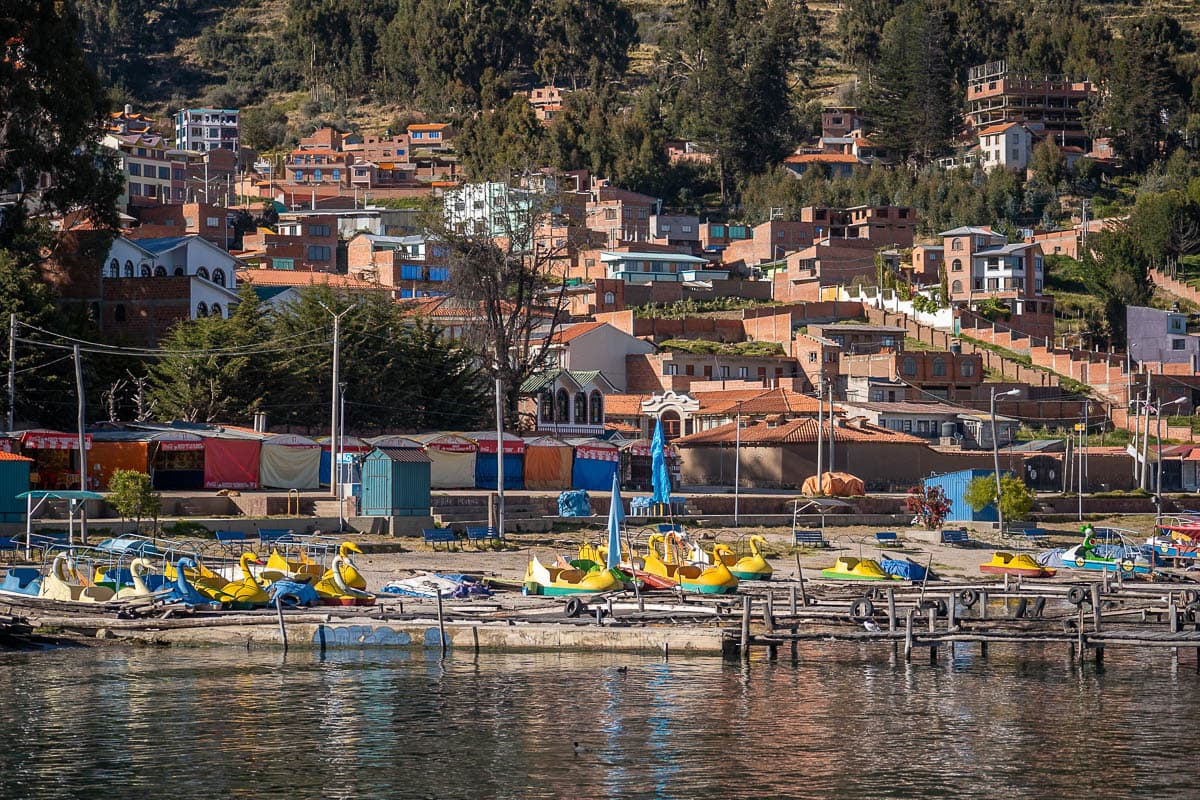
Alternatively, there are a handful of restaurants nearby with rooftop patios, like Coffe Bar Taipi Uta, that would be awesome to enjoy a chuflay while watching the sunset over the lake. I’d just advise against ordering food at these establishments—they’re famously overpriced, with seriously disappointing food offerings.
Where to stay in Copacabana, Bolivia
Like any proper touristy town, there are quite a few accommodations to choose from in Copacabana.
Here are a few places we’d recommend.
Hostal Las Olas
To be honest, the main reason we stayed in Copacabana as long as we did was to stay at this hotel, which has 13 uniquely designed suites that look straight out of a fairytale.

We actually wrote a whole article about our Hostal las Olas review, but, the TLDR is that this property was created by a sculptor/artist and it absolutely feels that way. Every detail here, from the railings to the sidewalks to the staircases, is meticulously designed in this whimsical fashion that makes you feel like you’ve been transported to some kind of magical fairyland.
There’s a hot tub that you can rent for around $7 USD per person per hour that overlooks Lake Titicaca and alpacas that roam the property and graze on the impeccable landscaping. And did I mention that you can stay here for as little as $34 USD per night?
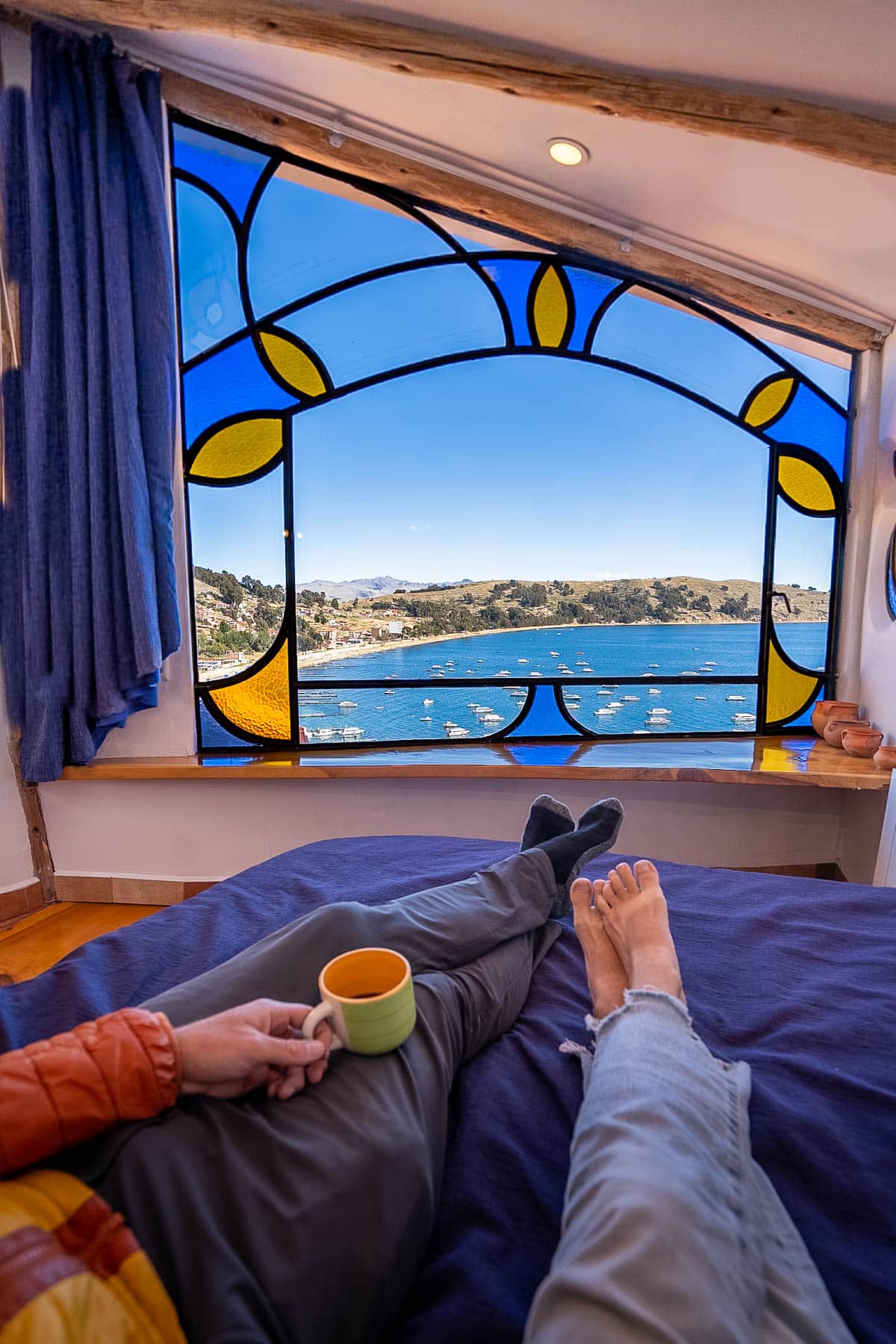
It’s seriously worth visiting Copacabana simply to stay at Hostal Las Olas—it’s definitely one of the coolest places we’ve ever stayed!
Hotel La Cupula
If Hostal las Olas is fully booked up, Hotel La Cupula, its neighbor, is a good backup.
It shares a lot of the same incredible features as Hostal las Olas, like jaw-dropping views of the lake, cool design (although, in this instance, it’s got more of a Santorini vibe than whimsical fairyland), in-room fireplaces, and resident alpacas.

Plus, there’s an onsite restaurant that offers guests complimentary breakfast and incredible homemade Bolivian food.
When to visit Copacabana, Bolivia
The best time to visit Copacabana is during its dry season, from May through October, when you have the best chance of clear skies (and, as a bonus, there’s incredible stargazing here!).
You have the highest chance of rain from December through March, although this also happens to be some of the warmest months in town. Accordingly, if you’re primarily interested in enjoying water activities, like kayaking or paddleboarding here, you may want to consider timing your visit within this timeframe. We visited in May and it was WAY too cold to do any kind of water activities!

As mentioned above, Copacabana sits at a pretty high elevation and can get pretty darn cold. It’s not uncommon for the temperatures to dip below freezing at night, especially from May through October.
Accordingly, be sure to double check whether your accommodations offer any kind of heating or fireplace, especially if you’re visiting during the colder months. Heaters are not common in this area and are really only installed in hotels and the like to appease tourists. We stayed for several days in an Airbnb that didn’t have heating and were wearing our parkas and beanies to bed every night!
Tips for visiting Copacabana, Bolivia
Cash is king
Most businesses here, including hotels, are cash only. Additionally, the few places that do accept credit cards will generally charge you a service fee.
There are a handful of ATMs in town (we used the one here several times without issue), but, like any small South American town, it’s not unheard of for the ATMs to run out of money or just not be working.

Accordingly, I’d recommend having some backup cash on hand, just in case.
Opening hours don’t mean anything
Businesses’ hours of operations, as listed on Google or even their own signage, are definitely more of a soft suggestion, not a guarantee.
So be flexible with your plans and have some back-up options at the ready, in case your first option (or even your second or third) happens to be closed.
You may need to acclimate
Remember that Copacabana is at a high elevation (12,600 feet above sea level), which can cause altitude sickness in certain travelers.
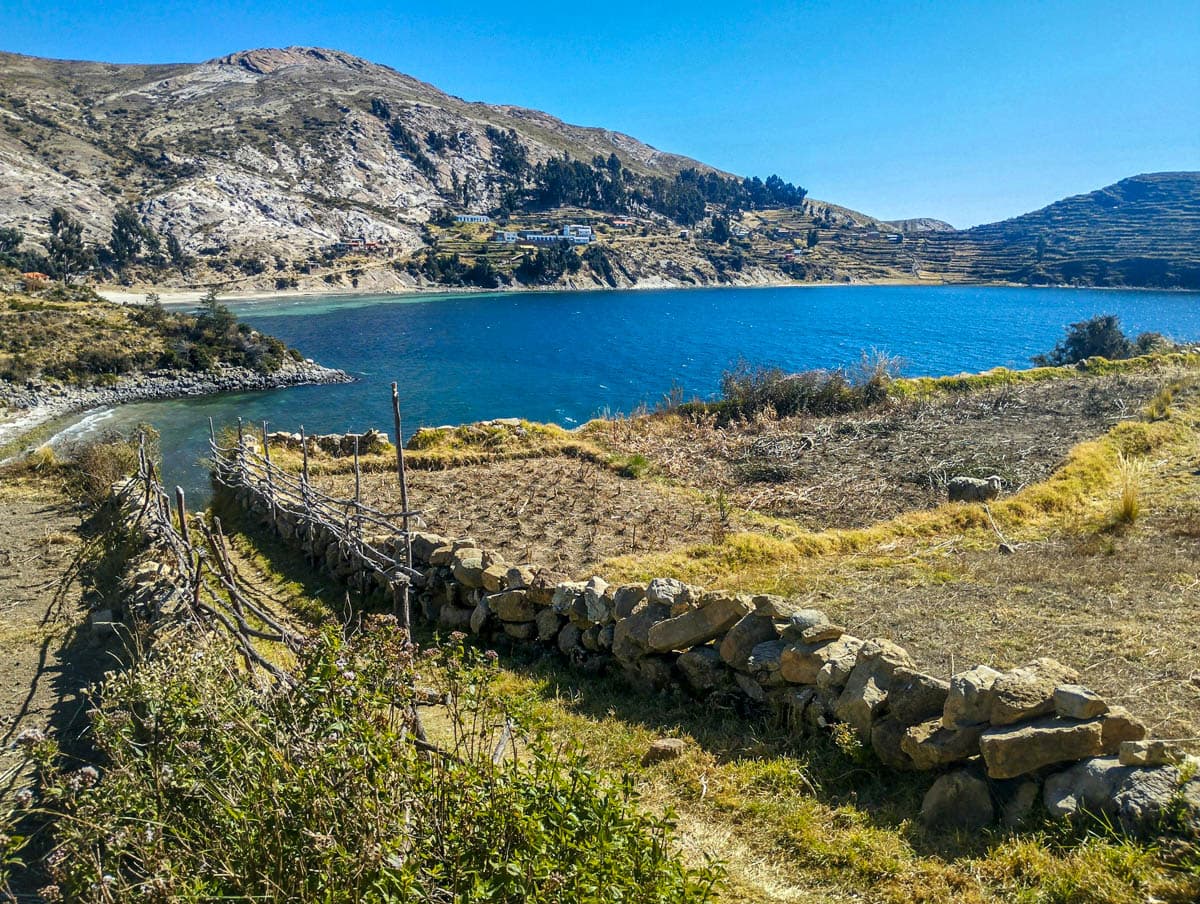
If you’ve been traveling around Peru or Bolivia for a while, it may not be too hard on you—for example, Cusco, Peru sits at 11,200 feet, whereas La Paz, Bolivia is at 11,975 feet. Still, remember to drink plenty of water, take it easy on alcohol, and don’t do anything too strenuous during your first day or two in Copacabana. Your body is already working overtime!
I hope you have a better idea of what to expect in Copacabana, Bolivia. Do you have any questions about visiting this unique town? Let us know in the comments below!
