

Iceland is a country of stunning waterfalls, but Hengifoss may just be its most beautiful. Not only is it the third tallest waterfall in Iceland, standing at an impressive 128 meters tall, but it also is one of the most unique looking. With its curtain of water cascading down a dramatic basalt cliffside striated with shockingly vibrant red volcanic layers, Hengifoss seriously looks straight out of Game of Thrones.
To reach Hengifoss, you are going to have to work a bit, climbing over 250 meters of elevation along the rim of a rocky canyon. Along the way, you’ll pass several smaller waterfalls and viewpoints of the canyon carved by the Hengifoss River, before you reach the cascade’s rocky base.
If you want to see it for yourself, here’s everything you need to know about hiking to Hengifoss, one of the most uniquely beautiful waterfalls in Iceland.

This post may contain affiliate links. If you make a purchase through them, we may receive a small commission, for which we are extremely grateful, at no extra cost to you.
About the Hengifoss Hike
- Length: 5.1 km (3.2 miles)
- Elevation gain: 265 meters (869 feet)
- Difficulty: Moderate
- Trail map
How to get to the Hengifoss trailhead
The Hengifoss trailhead is located here, near the tiny town of Hallormsstadur or about half an hour from the city of Egilsstaðir on the eastern side of the country.
Hengifoss is basically on the complete opposite side of the country from Reykjavik—about an eight and a half hour drive away. Accordingly, most travelers that are visiting are likely driving around the entire Ring Road of Iceland.
To reach Hengifoss, you can follow the Ring Road past Egilsstaðir to the town of Fellabær, turn left on Route 931, and follow it for 32 kilometers (20 miles).

Alternatively, if you’re heading from the south, you can shave off approximately 40 minutes of drive time by turning off Highway 1 at Berufjörður to continue straight on Route 939 for 20 kilometers, turning left on Route 95 for 32 kilometers, and then turning left and following the Lake Lagarfljót to the Hengifoss trailhead.
This is the way my husband, Justin, and I drove to Hengifoss.
Much of this shortcut, especially along Route 95, is up a narrow and windy gravel road up the side of a mountain, but you should be able to make the drive just fine in a standard passenger car when there isn’t snow or ice on the ground.

If you’re visiting during winter months, though, do not take this route (even if Google Maps suggests it!) and just drive all the way to Egilsstaðir on the Ring Road. This road can be extremely dangerous when it’s slippery.
How much does visiting Hengifoss cost?
Visiting the waterfall is free, but there is a 1,000 ISK charge per car to park in the lot. There’s a machine in the lot where you can pay or you can pay online here.
What to expect along the Hengifoss trail
This trail is a loop, following along either side of a deep canyon, carved into the craggy basalt by the Hengifoss River.
There isn’t a huge advantage of hiking the trail one direction or the other, but I’d suggest tackling it counterclockwise. This way, you can break up the uphill climb a bit by stopping at the viewpoint for Litlanesfoss, which is along the western half of the trail.

From the parking lot, follow the trail to the left, which immediately starts climbing uphill. The trail steeply climbs along the left side of a rocky canyon, crossing some small wooden bridges and offering views of several small waterfalls, cascading between the basalt gorge, along the way.
About 1.1 kilometers (0.7 miles) into the trail, you’ll reach the viewpoint for Litlanesfoss, a beautiful 30 meter tall, two-tiered cascade. It’s also known as Stuðlabergsfoss, which translates to “Columnar Basalt Falls”, given the waterfall is framed by an impressive collection of geometric columns of volcanic rock,

This is also a good place to look at the valley behind you and take in the sweeping views of Lake Lagarfljót below. The lake is known for its milky glacial waters and, at 53 square kilometers, is Iceland’s third largest lake.
Once you’re ready to continue on, the path gradually climbs upward, eventually crossing a small stream. As you climb higher and higher, you’ll get better views of Hengifoss with each step, towering off in the distance.
About 1.6 km (1 mile) into the trail, the gravel path flattens out a bit, before forking off to the left towards Hengifoss.
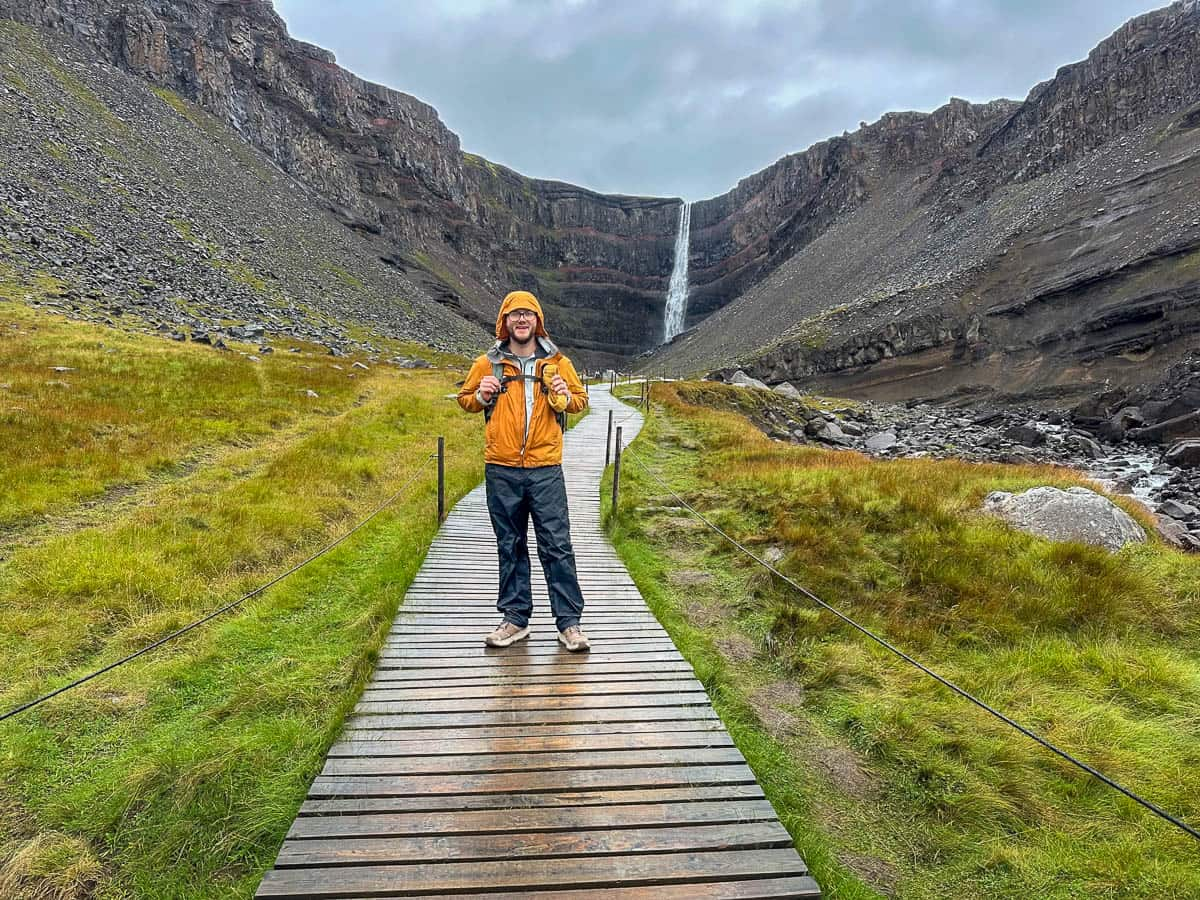
This path turns into a long wooden boardwalk. We hiked here while it was raining and this boardwalk was SO slippery for some reason, so I’d strongly recommend wearing proper hiking boots that provide traction (here’s the pair that Justin uses and here’s the pair that I use and love).
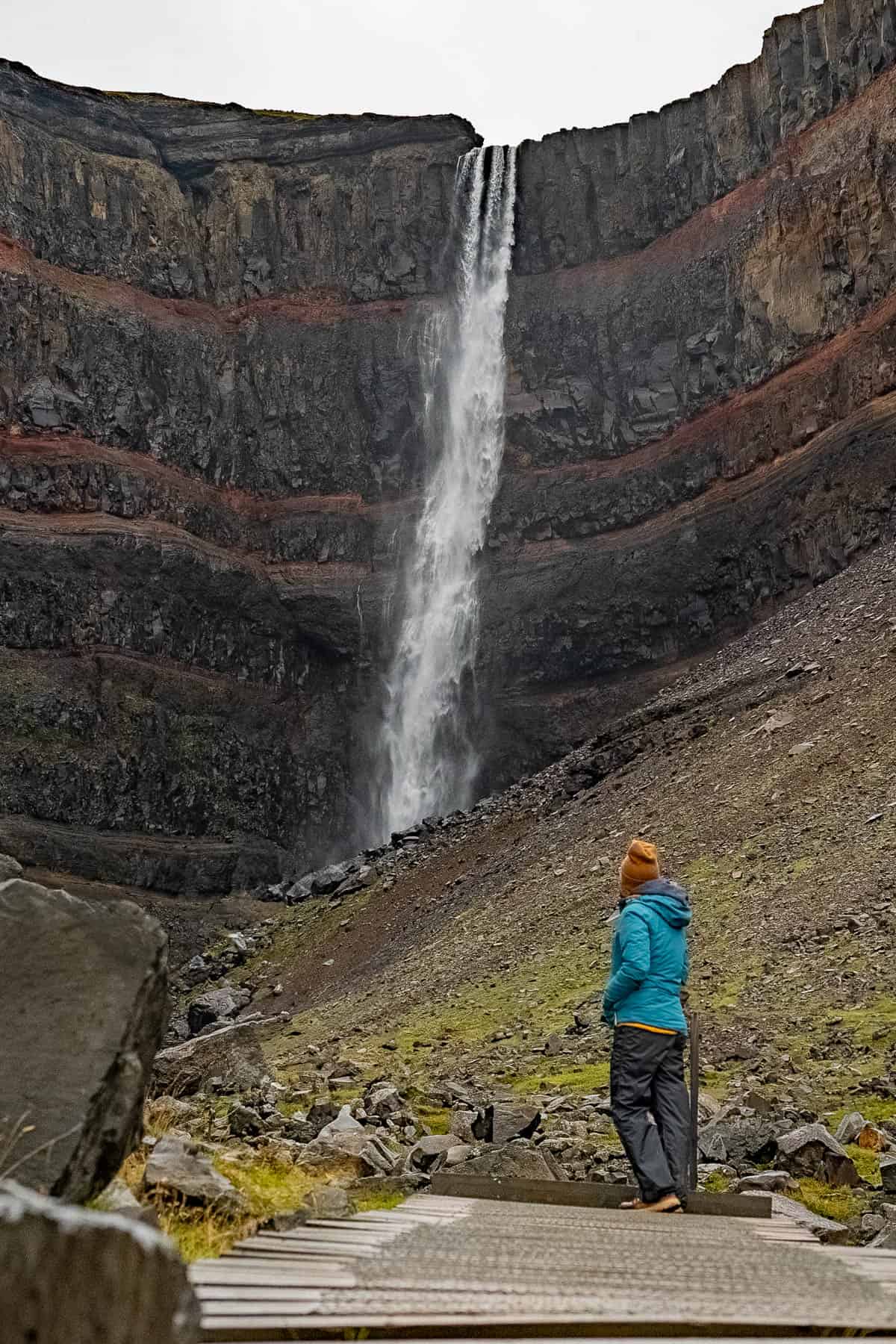
The boardwalk ends at a viewpoint, which is separated from the base of the waterfall by a boulder field. From here, you get a gorgeous view of one of the most beautiful waterfalls in Iceland, with the thin ribbon of water cascading down the striking black and red cliffside.
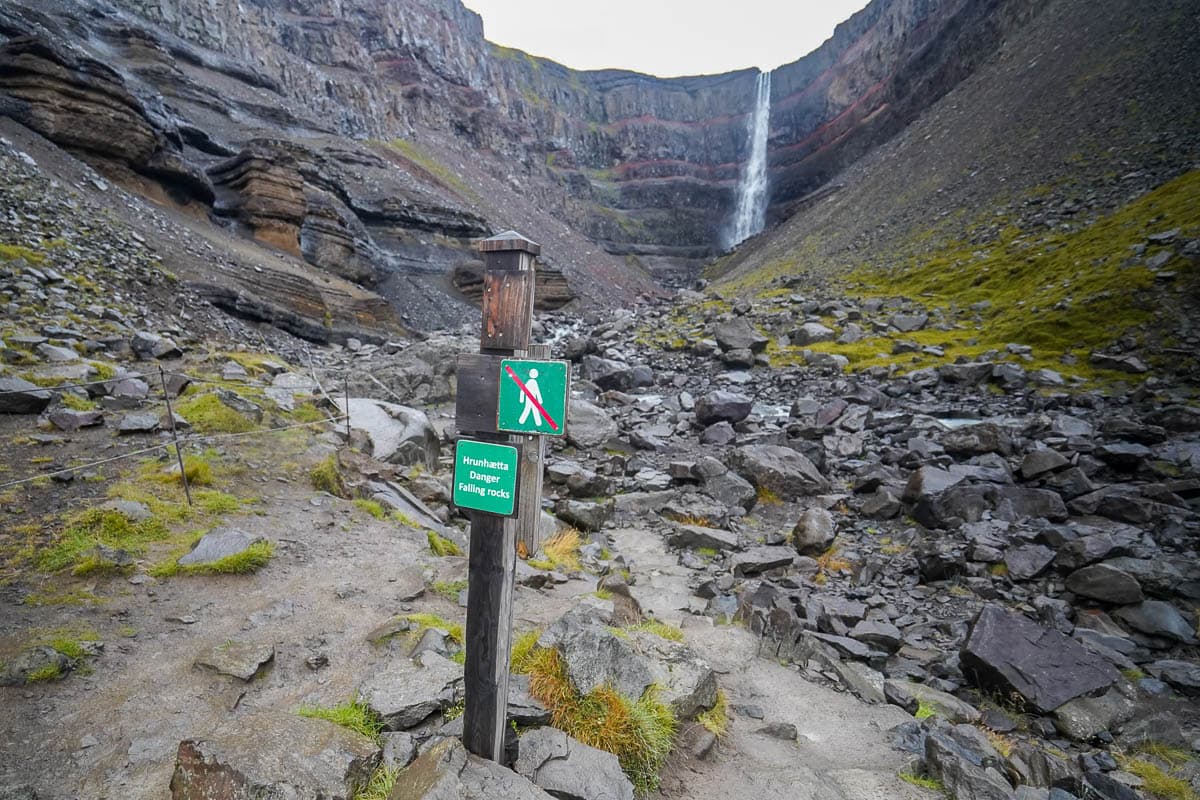
Out of everywhere I’ve visited in Iceland, I saw the WORST behavior of visitors at this Hengifoss viewpoint. There were SO many people hiking past the end of the wooden boardwalk into the boulder field that is clearly marked with a sign to not continue on and walking on the meadows surrounding the wooden boardwalks that are protected by ropes.

Please stay on the trail and abide by the signage here. Parts of this trail are on private land and if people continue to be disrespectful here, it may eventually be shut down and become inaccessible to future visitors.
From here, retrace your steps up the wooden boardwalk and head back downhill to the trailhead, along the pathway that follows along the eastern rim of the canyon.
When to visit Hengifoss
The trail to Hengifoss is open year-round. The best time to visit though, is from May through September. During this timeframe, the trail is ice and snow-free, with colorful wildflowers dotting the surrounding meadows.

While the trail is open during the winter months, there are definitely some drawbacks of visiting during this timeframe.
The steep pathway can get rather slippery with ice or snow, so I’d strongly recommend packing microspikes for extra traction. Additionally, the waterfall typically looks less dramatic—snow usually covers its striking red layers and its curtain of water is mostly (or completely!) frozen.
On the bright side, you have a much better chance of getting Hengifoss all to yourself, as compared to the busy summer months.
Where to stay near Hengifoss
There are several options of different kinds of accommodations near Hengifoss.
Hotels
The city of Egilsstaðir is the best place to stay near Hengifoss, with a handful of restaurants, a supermarket, and a convenient location along the Ring Road. Here are some hotel options in Egilsstaðir.
- Tehúsið: If you’re on a tighter budget, this warm hostel has options for dorm or private rooms with shared bathrooms, a shared kitchen where you can prepare your own meals, and an onsite restaurant with vegetarian and vegan options (which is hard to find around these parts!).
- Berjaya Hérað Hotel: This cozy and tidy hotel has a nice onsite restaurant and bar, spacious rooms with super comfy beds, and staff that are happy to help answer any questions you might have about eastern Iceland.
- Hotel 1001 Nott: For something a bit bougier, this hotel has beautiful rooms with views of the lake, stellar complimentary breakfast, and an outdoor hot tub, perfect for enjoying the Northern Lights.

Campgrounds
If you’re traveling around Iceland in a campervan or with a tent, good news—there are a TON of campgrounds near Hengifoss.
Justin and I stayed at Camping Mjóanes, which has a cozy lounge with a fireplace, hot showers, beautiful views of Lake Lagarfljót, and a very friendly cat. It was one of our favorite campgrounds during our two week road trip around Iceland.

Tjaldsvæði Hengifoss Gistihús is another option, right down the road from Hengifoss, which offers a hot shower and free wifi. Alternatively, Atlavik is a beautiful campground, right on the lake’s shores, with hot showers and even laundry.
I hope you have a better idea of what to expect when hiking to Hengifoss—it really is the most unique waterfall we’ve ever seen! Do you have any questions about visiting this unique place? Let us know in the comments below!
