

If you’re looking to get up close and personal views of one of Alaska’s most stunning glaciers, the Portage Pass Trail, located in the small fishing village of Whittier, is one of the best day hikes in this gorgeous state, offering jaw-dropping views of the Prince William Sound, the surrounding snowcapped Chugach Mountains, and, of course, the Portage Glacier. If you want to experience this incredible hike for yourself, here’s everything you need to know about the Portage Pass Trail.

This post may contain affiliate links. If you make a purchase through them, we may receive a small commission, for which we are extremely grateful, at no extra cost to you.
About the Portage Pass Trail
The Portage Glacier has been a popular destination in Alaska for quite some time. In fact, the glacier got its name, given that Native Alaskans, Russian fur traders, and gold rushers, used to use the glacier to carry gear (i.e., portage) between the Turnagain Arm, on the west side of the Chugach Mountains, and the Prince William Sound, to the east.
It’s also one of the most accessible glaciers in Alaska—you can easily get incredible views of it, using your own two feet, along the Portage Pass Trail. Better yet, while this trail has some challenging sections, it’s definitely doable for most hikers in decent shape.

Here’s some quick stats about the trail, so you know what you’re getting into:
- Length: 4.6 miles
- Elevation gain: 1,463 feet
- Difficulty: Moderate
- Dog friendly? Yes, but your furry best friend needs to stay on a leash. There are also bears—primarily black but some brown bears—that live around Whittier, so be sure to keep a close eye on your pup and stay aware of your surroundings to decrease the likelihood of an aggressive encounter.
- Permit or fee? None, the Portage Pass Trail is FREE!
- Trail map
How to get to the Portage Pass trailhead
The Portage Pass Trail is located in the Chugach National Forest in the teeny town of Whittier, located about an hour and 15 minutes south of Anchorage.
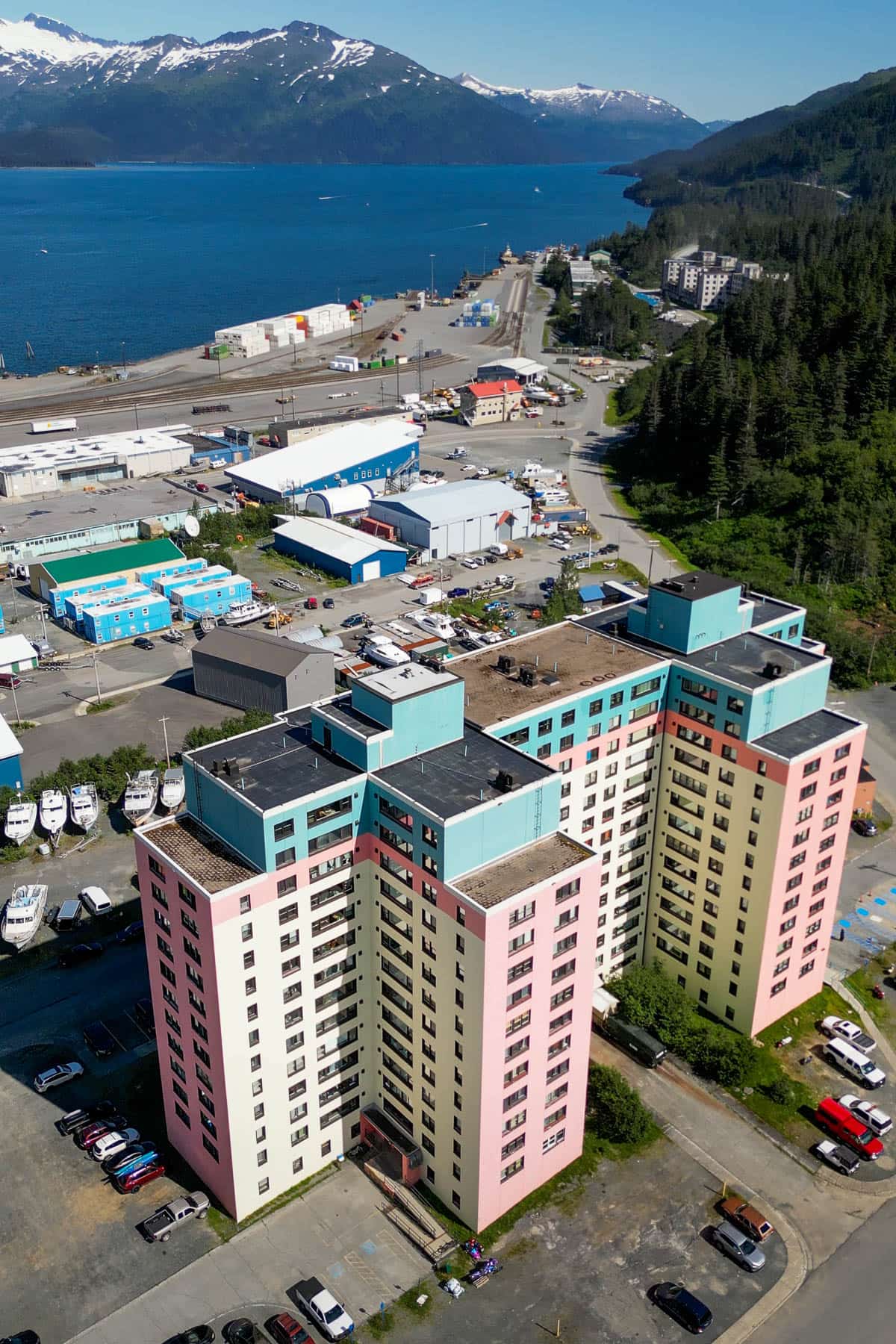
Alaska is full of quirky towns and Whittier is DEFINITELY no exception. The town was actually established in 1941 as a secret U.S. army military base, selected for its year-round ice free harbor and the omnipresent cloudy skies here that made it difficult for the Axis Powers to find it with radar.
As you might imagine a secret military base would be, Whittier is definitely nestled away in Alaska’s epic landscape, tucked between the Chugach Mountains and the Prince William Sound. So, it’s not exactly the most straightforward place to get to.
Still, you do have a few different options of how to get to Whittier.
Driving to Whittier
From Anchorage, most of the drive is along the stunning Turnagain Arm, a gorgeous fjord-like inlet along the Cook Inlet, lined by the Kenai Mountains.

After driving on Highway 1 along the Turnagain Arm, you’ll turn onto Portage Glacier Road and drive east about five miles. Along the way, you’ll pass some interesting stops, including the Williwaw Salmon Viewing Area, where you can see THOUSANDS of spawning salmon in August and September, and the Begich, Boggs Visitor Center, which has some interesting exhibits on glacial activity and the surrounding geology and wildlife.
From here comes the slightly tricky part of driving to Whittier—the only way to drive to the town is via a two and a half mile long tunnel, the Anton Anderson Memorial Tunnel, straight through Maynard Mountain. The tunnel was originally built to help transport equipment to and from Whittier via train during World War II.
Driving through the Anton Anderson Memorial Tunnel should definitely be on your Alaska bucketlist—it’s still the longest combined vehicle-railroad tunnel in North America!

However, you do have to plan slightly ahead to drive through it.
First of all, it’s only open from 5:30 am to 11:15 pm, from May through September, and 7:00 am to 10:45 pm through the winter months.
And, at any given time, the traffic only flows one-way, with the direction changing every half an hour. You can check the schedule here.
Finally, there are some pretty hefty tolls for driving through the tunnel, which start at $13 USD (roundtrip) per passenger car—you can check out the cost of tolls here.

Despite the minor challenges of driving here, it’s well worth the effort—there are tons of cool things to do in Whittier, from sailing past the glaciers in the Prince William Sound to, of course, hiking the Portage Pass Trail.
Once you’ve made it through the Anton Anderson Memorial Tunnel, the trailhead, located here, is just about half a mile down the road. The last 0.3 miles of the drive is along a dirt road, but, when my husband, Justin, and I drove on it, it was easily accessible for any passenger vehicle, so long as you keep a lookout for potholes.
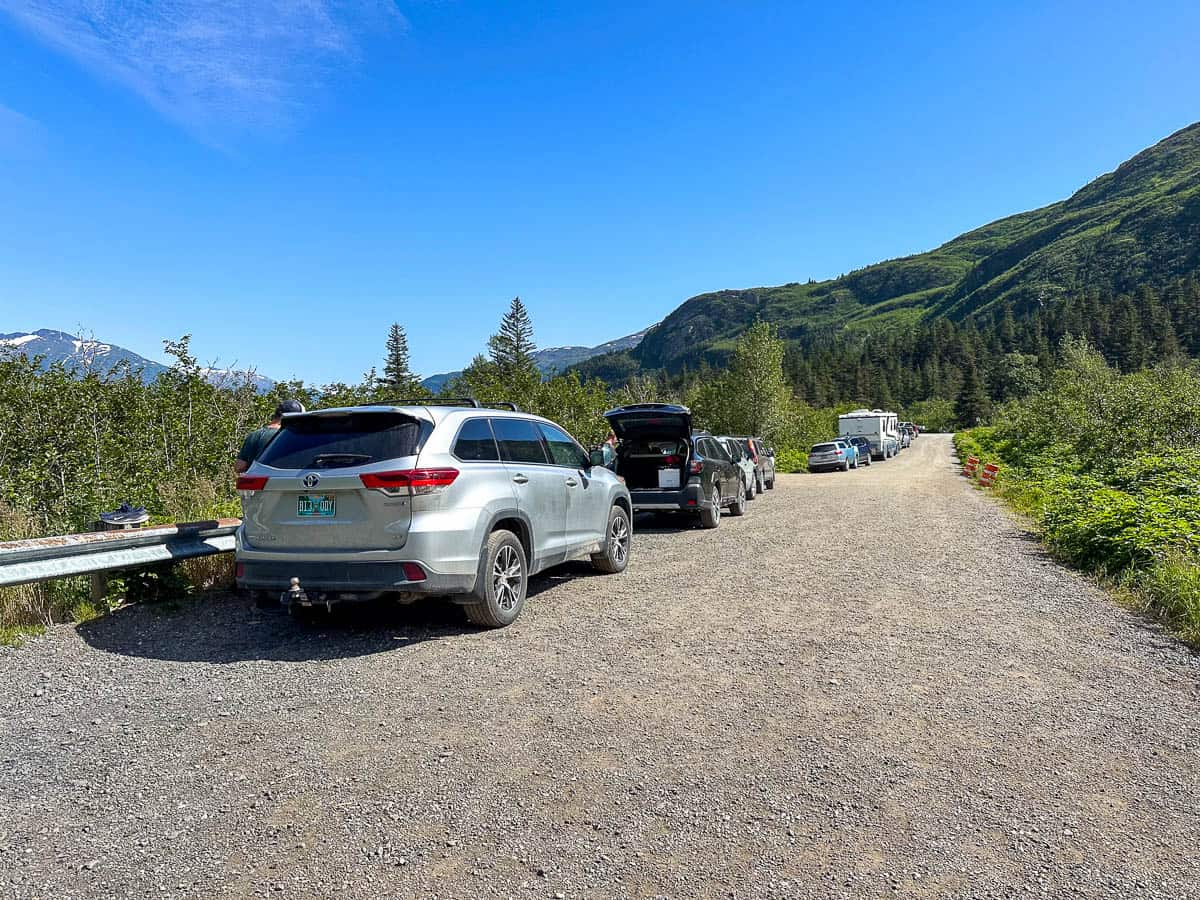
There’s also a fairly new, large gravel lot with plenty of parking spots, so, regardless of when you visit or what kind of rig you’re driving, you should be able to find a spot just fine.
Taking a ferry to Whittier
Another option to get to Whittier is to take the ferry, operated by the Alaska Marine Highway, from the small town of Valdez, located along the coastline of Prince William Sound.
If you’re roadtripping around Alaska, Valdez should ABSOLUTELY be on your bucketlist—after driving all over the state for three whole months, this was probably our favorite town in all of Alaska! There are just so many cool things to do in Valdez, from watching sea lions feast at the largest single species salmon hatchery in North America to kayaking with icebergs on a glacial lake.

If you’re planning on visiting Valdez, I can’t imagine a more peaceful and beautiful way of getting to Whittier than sailing on a six hour ferry through the Prince William Sound, with constant views of glaciers, mountains, and, with any luck, wildlife, like otters and whales along the way.
If you happen to be traveling by ferry sans car, just be aware that you’ll have to walk 1.7 miles (one-way) from the ferry terminal to the trailhead along a mostly flat road.
Taking the train to Whittier
One of the most underrated things to do in Anchorage is hop on an Alaska Railroad train, which offers stunningly scenic routes as it either heads up north to Denali and Fairbanks or south to the Kenai Peninsula. And one of their routes, the Glacier Discovery train, actually stops right in Whittier!
From June through mid-September, the train leaves Anchorage on a daily basis at 9:45 AM, arriving in Whittier at 12:05 PM. From here, you’ll have all afternoon to explore Whittier, whether you just plan on hiking the Portage Pass Trail, getting some very fresh fish and chips, or hopping on an Alaskan cruise (more on that below!).
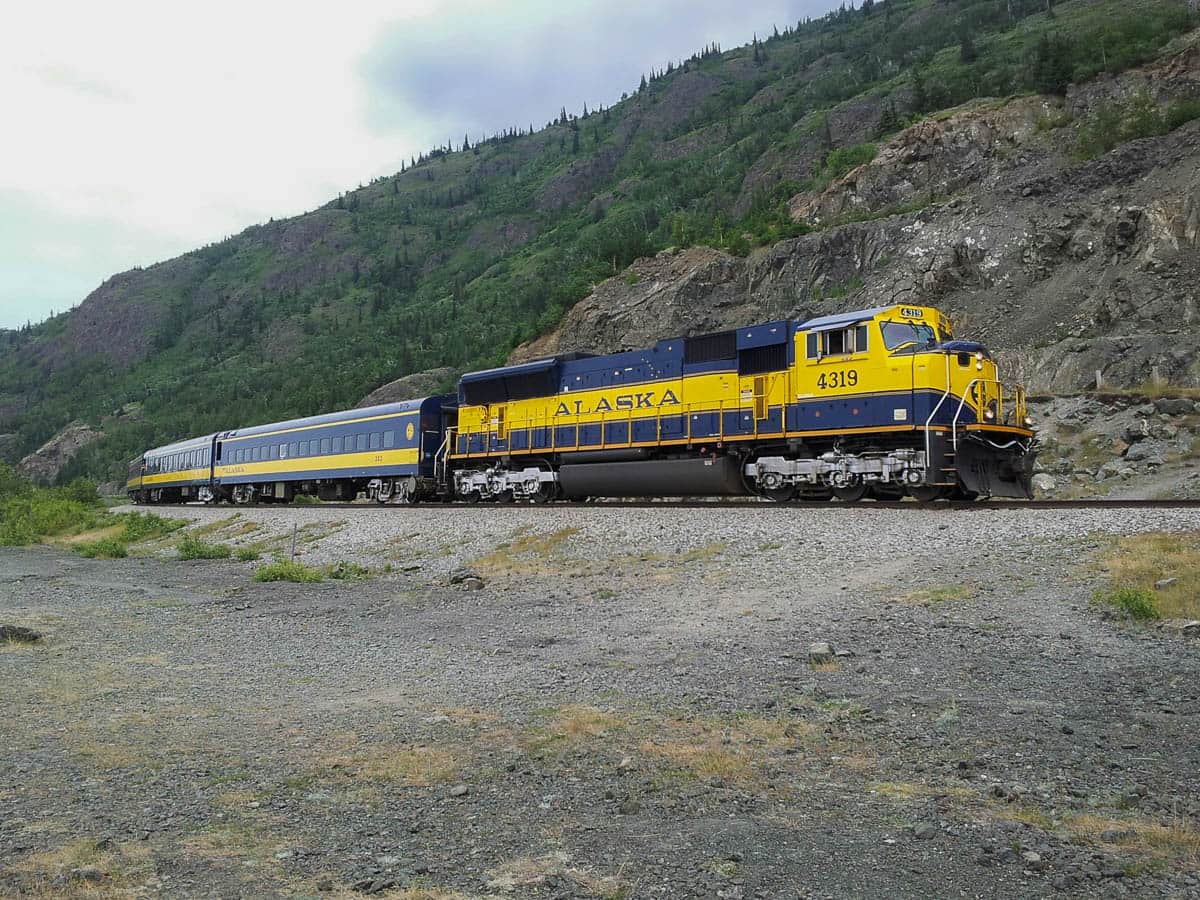
If you plan on returning to Anchorage, the train departs from Whittier at 6:45 PM. arriving back to the city around 9 PM.
Similar to if you’re arriving by ferry, you’ll have to walk from Whittier’s train depot to the Portage Pass trailhead, which is about 1.3 miles (one-way) along a fairly flat roadway.
Cruising to Whittier
Finally, it’s worth mentioning that thousands of visitors reach Whittier every year on an Alaskan cruise.
While you might assume that many Alaskan cruises would start or end in Anchorage, the state’s largest city actually doesn’t have a large commercial cruise port. Instead, most large cruise ships dock in either Seward in the Kenai Peninsula, home to Kenai Fjords National Park, or in Whittier, with passengers transiting by shuttle to and from Anchorage.

Whether you’re starting, ending, or just passing through Whittier on your Alaskan cruise, it’s the perfect opportunity to check out the Portage Pass Trail. However, if you’re starting from the cruise terminal, you’ll have to walk 1.3 miles (one-way) to the trailhead along a fairly flat roadway.
What to expect on the Portage Pass Trail
From the trailhead, the pathway immediately starts steeply climbing, along an old road. As you climb higher and higher, the views of Maynard Mountain keep getting better and better. Be sure to turn around, every once and a while, because the view of the Prince William Sound behind you might be even better!
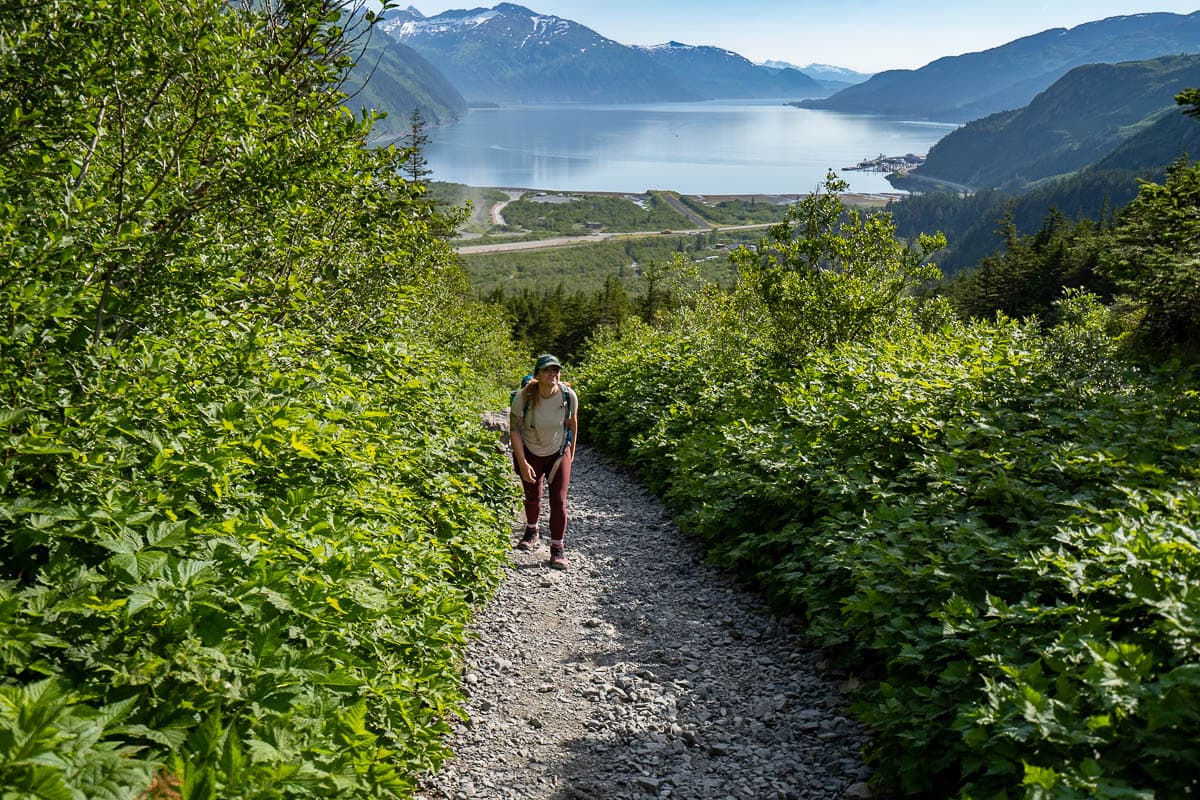
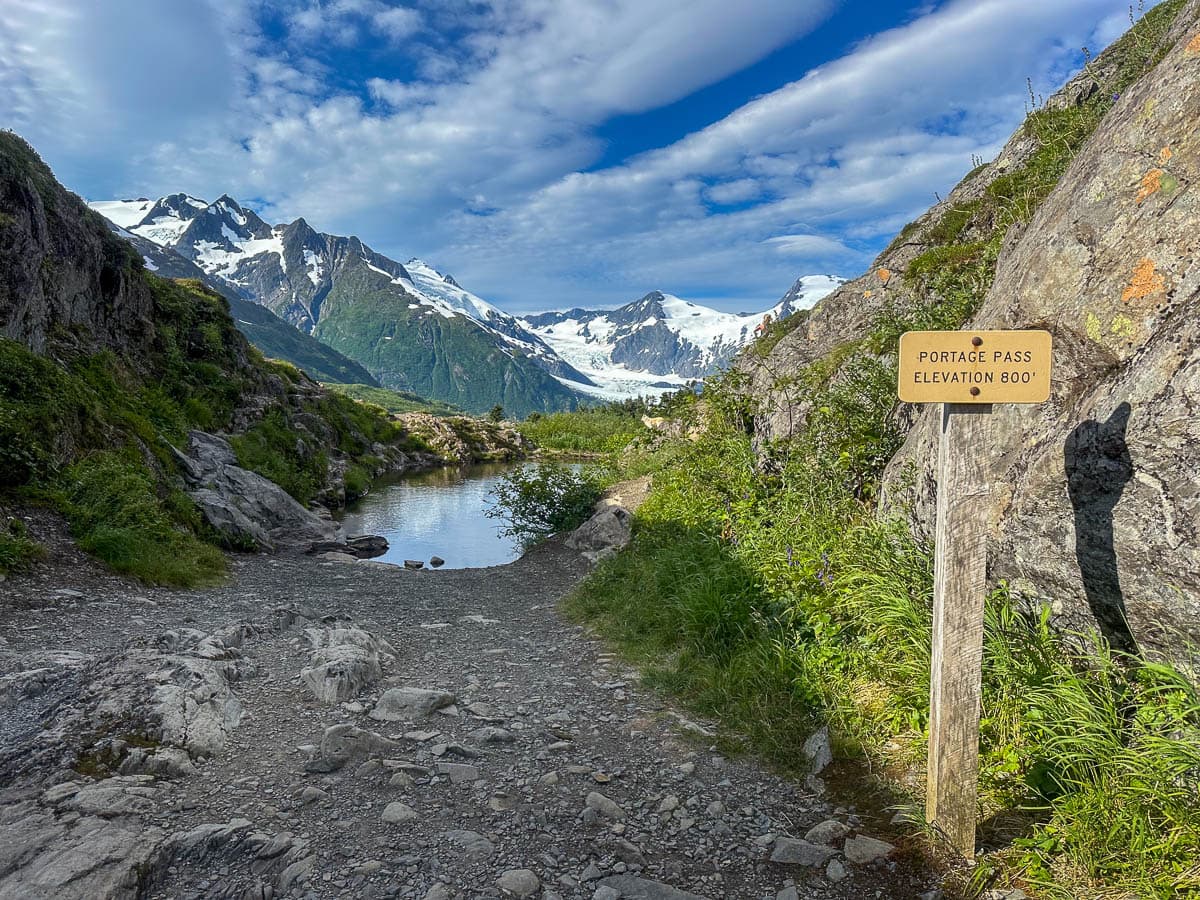
Over the next 0.8 miles, you’ll climb about 700 feet up to Portage Pass, a ridgeline between two rocky towers with stunning views of the Prince William Sound to the northeast, the Portage Glacier to the southwest, and dozens of mountain peaks in every direction. If you’re short on time or not keen to do any more elevation, this is a popular endpoint for some hikers, allowing you to take in some of the best vistas along the trail, with only half of the elevation gain of the full hike.
If you’re feeling more adventurous, there are some rocky outcroppings that you can scramble up to get even better views of the town of Whittier in the valley below and beyond, the Leonard Glacier and the surrounding Chugach Mountains.
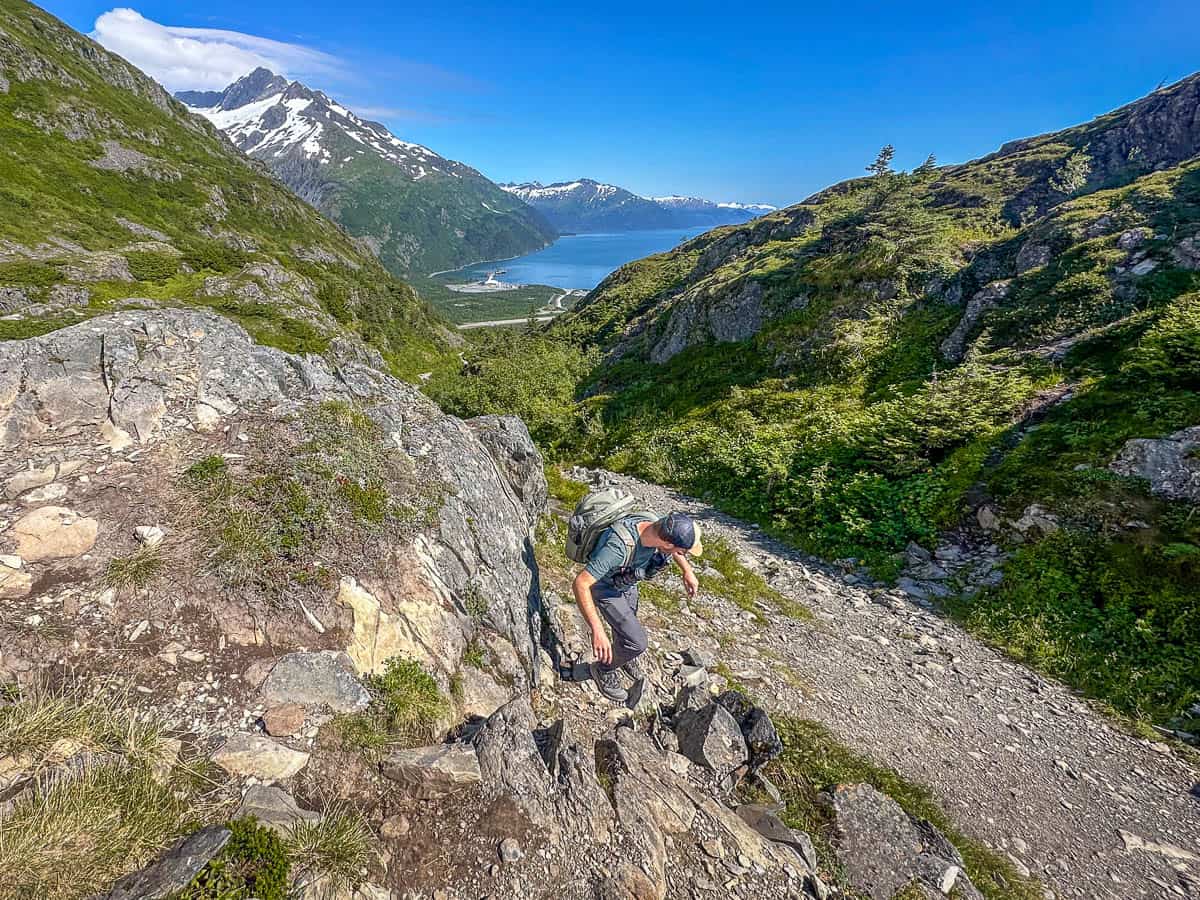
If you decide to press on (which I’d totally recommend!), the trail starts descending down towards Portage Lake, the body of water fed by its namesake glacier. Along the way, you’ll pass the small, but pretty Divide Lake, which has a stream that follows along the trail the rest of the way down to Portage Lake.
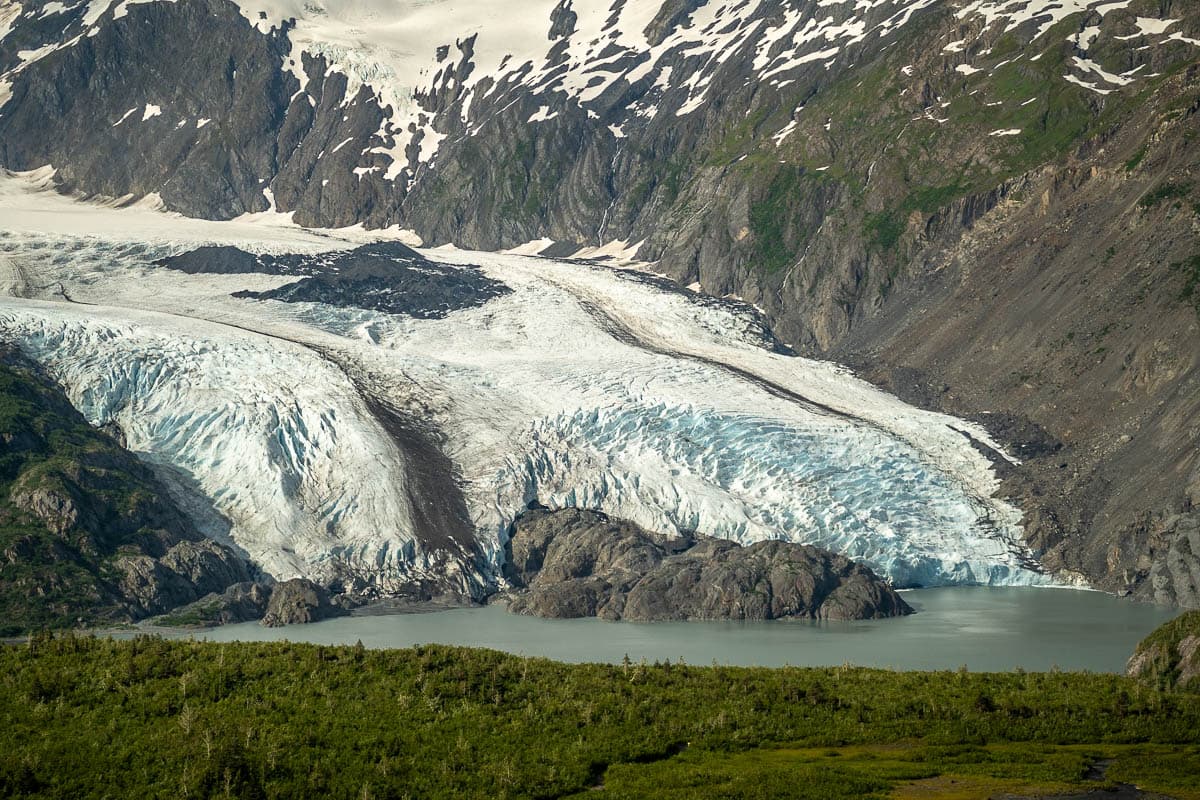
After you descend back down about 700 or so feet, you’ll end up on a rocky beach alongside the Portage Lake and beyond, the absolutely massive Portage Glacier.

It’s pretty wild (and a bit sad!) to think that the glacier once filled much of this valley. Back in the early 1900s, you used to basically be able to reach out and touch the glacier from where the Begich, Boggs Visitor Center now stands. However, the glacier has now receded approximately three MILES(!!) since then, with this massive sheet of ancient ice scouring out the basin for the 600 foot deep Portage Lake.
Glacial recession notwithstanding, the views along the beach here are absolutely SPECTACULAR, with wildflowers, mountain peaks, and the stunning glacier in pretty much every direction you look. We enjoyed a lovely lunch here, just listening to the creaking of the glacier and drinking in the gorgeous views of Alaska around us.
When you’re done, simply retrace your steps back to the trailhead.
Pssst… if you’re not up to hiking to the glacier (or you simply can’t get enough of glaciers!), the most popular activity in Whittier is a 26 glacier cruise, like this option, which passes (you guessed it!) 26 glaciers along the western side of the Prince William Sound—no hiking required!
When to hike the Portage Pass Trail
The best time to hike the Portage Pass Trail is from June through September, when the trail is ice and snow-free. We hiked the trail in early August and it was absolutely PERFECT, with sunny skies and vibrant wildflowers lining the trail.
Outside of this window, there’s a good chance you might encounter snow on the trail.
During the wintertime, you can actually snowshoe along the trail (here’s the snowshoes that I have and here’s the pair that my husband has), with most hikers stopping at Portage Pass. If you opt to hike the Portage Pass Trail during this timeframe, be aware that there are some avalanche chutes along the trail, so I’d only recommend attempting this trail if there’s a low risk of avalanches on the day you head out AND you’re equipped with the appropriate safety know-how and gear, like this avalanche safety kit.

Another alternative to consider in the wintertime is hiking from the Begich, Boggs Visitor Center, across the frozen Portage Lake, to the face of the Portage Glacier.
We chatted with some locals along the Portage Pass Trail, who said they loved hiking to the glacier this way. However, this hike seems EXTREMELY risky to me—unless you’re somehow positive that the lake is completely frozen over and thick enough to walk on, there’s a risk that you could fall through the ice, into a 600 foot deep body of freezing water. So, I’d only recommend doing this with a knowledgeable guide and at your own risk!
What to bring along the Portage Pass Trail
One of my favorite things about hiking is that you don’t really need too much gear to have a great time. Still, here are a few things to include on your Alaska packing list to make your time in Whittier that much better.
Waterproof hiking boots
Like most of the hiking trails we did in Alaska, there were some serious muddy patches and enormous puddles along the Portage Pass Trail. I’d recommend wearing waterproof hiking boots, like this option for women and this option for men, which will protect your feet against the seemingly omnipresent mud and provide additional support and traction along some of the rockier sections of the trail.
Trekking poles
The ascent and descent from the trailhead up to Portage Pass is pretty steep, climbing 700 feet in just 0.8 miles.
I’d recommend bringing along trekking poles, especially if you have knee issues, to offer a bit of extra support, especially on some of the downhill sections.
Bugspray
I’m sure you’ve heard the old joke that mosquitoes are the official state bird of Alaska. We definitely found that to be true in some areas of the state (I’m looking at you, Grewingk Glacier Trail), but we actually didn’t really have an issue with them in Whittier.

Still, it’s best to have a bottle of bug spray in your backpack just in case you have worse luck with them than we did!
Bear spray
As mentioned above, bears are frequently spotted in and around Whittier, including around the Portage Pass Trail. Bears generally don’t want anything to do with humans, but they can get aggressive when they’re trying to fatten up for their winter hibernation or they’re trying to protect their young.

We always carry this bear spray when we’re hiking in bear country to protect ourselves in the unlikely event we encounter a bear that’s displaying aggressive behavior.
Rainjacket
Unfortunately, the most pervasive saying about this cute town is “The weather is shittier in Whittier.” As mentioned above, the town was specifically established here by the U.S. military, due to the presence of heavy clouds!
We camped in our RV, right next to Whittier, in the town of Girdwood and waited out about seven rainy days, until we got a gloriously sunny one that was perfect for exploring the town.
But, if you don’t have quite as flexible a schedule as we do, I’d recommend packing along a solid rainjacket (here’s the one that I use and here’s the one that Justin uses) and a sunny attitude, just in case the old adage about Whittier holds true.
Water
Justin and I each pack along our comically giant Nalgene bottles, which should offer plenty of water for a hike of this length.

Sunscreen
Most of the trail is totally exposed to the sun, plus, it can feel even more intense, with sunlight reflecting off the glacier and Portage Lake. I’d recommend packing along sunscreen, a hat, and sunglasses—it was SO bright the day we visited the Portage Pass Trail!
Microspikes
If you’re hiking on the early or later side of the summer timeframe, I’d recommend bringing along microspikes, as icy spots can linger on the trail well into June or can appear as early as September!

Cash or credit card
If you’re driving to Whittier, remember that you’ll have to pay the toll to drive through the Anton Anderson Memorial Tunnel!
I hope you enjoy the Portage Pass Trail—it was one of our favorite day hikes in Alaska! Do you have any questions about this trail? Let us know in the comments below!
