

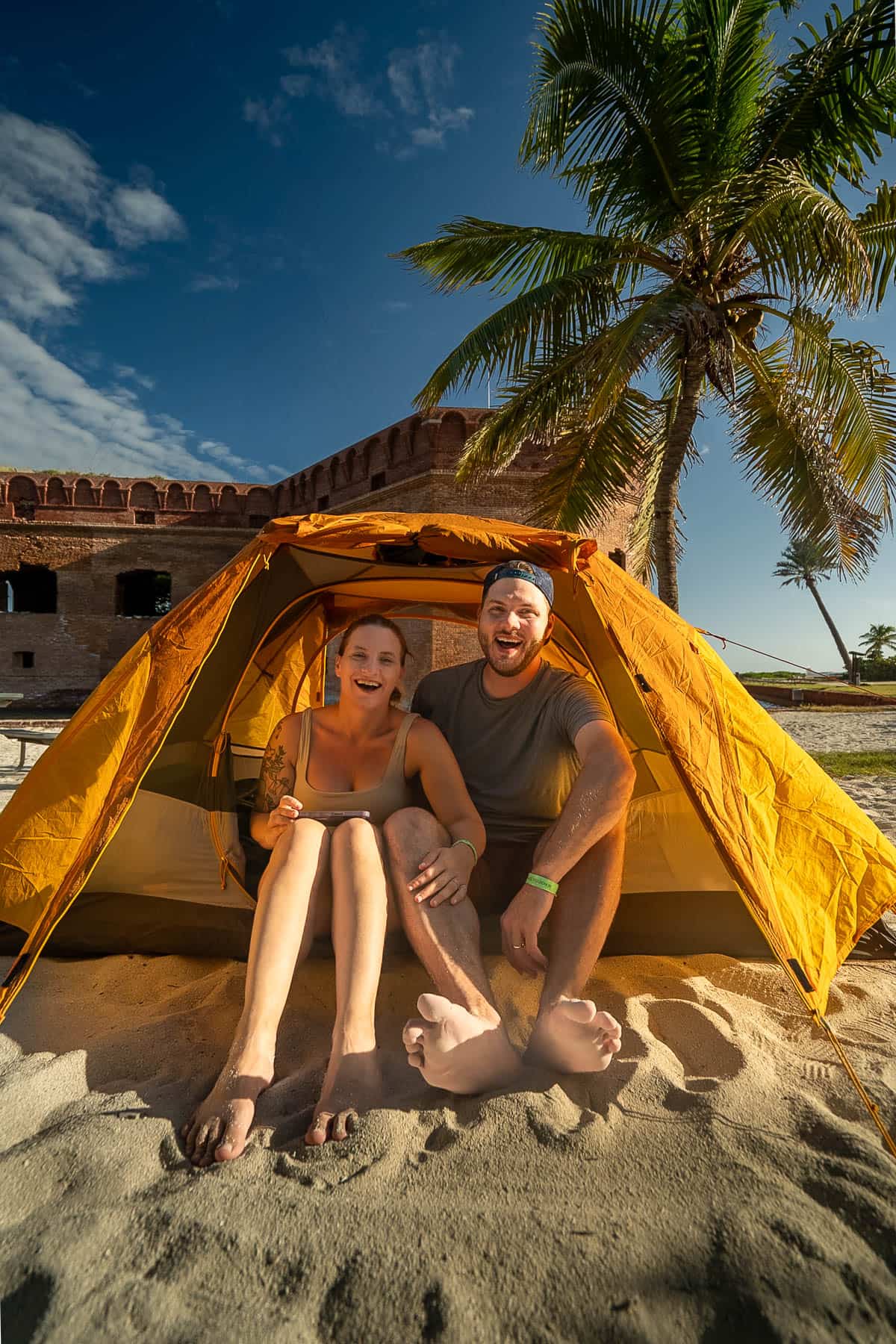
Dry Tortugas National Park, located 70 miles off the coast of Key West, Florida, is the most remote national park in the Lower 48. The park consists of seven isolated islands in the Gulf of Mexico, only a few of which travelers are allowed to visit. Most people visit the park as a day trip from Key West, but, for a lucky few adventurous travelers, you can actually camp in Dry Tortugas National Park, allowing you to take in the punchy sunsets, starry skies, and pristine beaches—essentially all to yourself. My husband, Justin, and I have visited over 40 U.S. National Parks and camping at Dry Tortugas is easily one of our favorite experiences in our beautiful public lands.
So if you want to experience one of the most unique and remote places that the contiguous United States has to offer, here’s everything you need to know about camping in Dry Tortugas National Park.

This post may contain affiliate links. If you make a purchase through them, we may receive a small commission, for which we are extremely grateful, at no extra cost to you.
What is Dry Tortugas National Park?
Dry Tortugas National Park consists of seven small islands that make up the southernmost part of the Florida Keys. The park sprawls for approximately 100 square miles, most of which is just beautifully turquoise water, which is home to a colorful coral reef and plentiful wildlife, including sea turtles, sharks, and unique birds, some of which are found nowhere else in the continental United States.
The largest island—which happens to be the only one that most visitors step foot on—is Garden Key. Within the island’s 14 acre footprint, you’ll find white sandy beaches, swaying coconut trees, and, most interestingly, the absolutely MASSIVE Fort Jefferson, which is constructed of 16 MILLION bricks and is the largest brick structure in the Western Hemisphere.

Fort Jefferson was originally constructed to bolster coastal defense in this region, but primarily served as a prison during the Civil War, to house deserters of the Union Army and other criminals. Its most famous inmate was Dr. Samuel Mudd, who co-conspired with John Wilkes Booth to assassinate Abraham Lincoln. The fort was abandoned by the 1870s, having never fired a single cannonball and without its construction being completed.
Getting to Dry Tortugas National Park as a camper
The very first thing you need to plan for your camping trip to Dry Tortugas is how you’re going to get there. Visiting Dry Tortugas National Park is a bit tricky, even for day passengers, and is WAY more competitive for campers.
There are essentially two different ways that you can get to Garden Key as a camper from Key West.
Booking tickets aboard the Yankee Freedom Ferry
The most popular and accessible method of getting to Dry Tortugas National Park as a camper is to secure tickets on the Yankee Freedom Ferry, which makes the two and a half hour trip (one-way) between the Historic Seaport in Key West and Garden Key.
Every day, there are ten tickets aboard the ferry that are reserved for campers, amongst the 175 tickets for its total passengers. You can book up to three nights of camping on the island, which you’ll need to choose when you purchase your ferry tickets.

Visiting Dry Tortugas is one of the most popular things to do in Key West, so ferry tickets for daytrippers often sell out months ahead of time. This is especially true in the busy months of November through March, with tickets for campers often selling out just a few days or even hours after they initially go on sale.
Tickets go on sale six months ahead of time, on the first business day at 8 AM EST (e.g., tickets for September will typically go on sale April 1 or tickets for June will go on sale January 1). Accordingly, if you’re trying to visit Dry Tortugas within a certain timeframe, I’d strongly recommend setting an alarm for the date and time they go on sale so you can snag tickets as soon as you can!

Roundtrip tickets for campers aboard the Yankee Freedom Ferry generally cost $255, which is just $5 more than daytrippers.
If you have an America the Beautiful Pass or other interagency pass for the US National Park system, you can receive an additional $15 off per person for up to four passengers (just be sure to bring your pass as they’ll check it at the ferry terminal).
Your ticket includes breakfast, lunch, and snorkeling gear rental for the duration of your time on the island.
Taking a private boat or seaplane
Other than taking the Yankee Freedom Ferry, the only other option is to get to Dry Tortugas as a camper is to take a private boat or seaplane.

There is one public seaplane company, Seaplane Adventures, that is allowed to take day trip passengers to and from Dry Tortugas every day, but, per their contract with the National Park Service, they are not allowed to drop off or pick up campers.
The Campground at Dry Tortugas National Park
Camping at Dry Tortugas National Park is primitive, meaning you have to bring all of your own gear, food, and water. There’s no running water and electricity here, with limited amenities for campers.
All campsites are first come, first serve. There are eight regular campsites on Garden Key, which are sprinkled throughout a buttonwood tree grove, some of which are along the treeline or in the trees themselves. Each site has its own picnic table, grill, and post to hang a garbage bag and costs $15 per night (cash only!).

Each site accommodates up to six people. If you have a larger group (i.e., 10-20 people), there’s one group campsite that has space for up to 15 tents that has to be reserved ahead of time with the national park. You can make a reservation here.
To be honest, first come, first serve sites always cause me a bit of anxiety, especially when they involve a pretty expensive ferry ticket and sailing 70 miles into the open ocean, but, for Dry Tortugas, there’s really no reason to worry. Every camper, once on the island, is guaranteed a campsite, and, if somehow all of the normal campsites are full, there’s a grassy area near the campground that is treated as an overflow area for other campers.
What to expect while camping at Dry Tortugas National Park
The vast majority of the people who camp and generally visit Dry Tortugas take the Yankee Freedom Ferry, so this guide is mostly geared towards them. However, there are still plenty of tips throughout this post that will be helpful if you happen to have a really dope friend with a private boat or seaplane that can take you to Dry Tortugas.
Where to park if you’re camping in Dry Tortugas National Park
If you’re taking the Yankee Ferry to Dry Tortugas, the closest garage to the ferry terminal is the City Parking Garage on Grinnell Street in Key West, which charges $40 USD per day.

There are tons of parking lots within walking distance of the ferry terminal, many of which offer more competitive pricing than the City Parking Garage—just make sure they allow overnight parking or you’ll risk getting towed! We parked at this lot, which costs just $15 per day and was a 10 minute walk from the ferry terminal.
Arriving at the Ferry Terminal
Campers taking the Yankee Freedom ferry must arrive at the Ferry Terminal by 6 AM on the date of their departure.
We arrived right at 6 AM, with the other two groups of campers that were staying at the park that night. We waited around until about 6:30 AM, when a Yankee Freedom staff member came down to give us a quick briefing of what to expect and inspected the contents of our bags.

I think they’re mainly looking for compressed gas, like propane or butane bottles, and liquid fuel, like lighter fluid or kerosene, which are prohibited on the ferry (more on this later!), but there are other items that are not allowed onboard as well, such as weapons, including knives that are longer than 2.4 inches in length, or fireworks.
Once your briefing is over, you’ll be given wheelbarrows, if necessary, to carry your gear down to the ferry for it to be loaded onto the ship. Once they’re dropped off, you’ll have about 45 minutes of free time before you have to come back to board the ferry, which departs at 8 AM During this timeframe, I’d recommend walking a couple blocks over to pick up an iced cafe con leche from the Cuban Queen, which has AMAZING coffee and even makes its ice cubes out of coffee!

Insider tip:  There’s limited seating inside of the ferry, with about half of its passengers needing to sit in its exterior spaces. Even if you luck out with a day with absolutely perfect weather, the UV rays can feel INTENSE while sitting on the exterior deck, and, in the worst case scenario, you’ll be forced to sit in the wind or rain for two and a half hours.

Passengers board the ferry in groups, according to their boarding ticket, with lower numbers getting to embark and select their seats first. When we dropped off our bags at the ferry, we were told to be back by 7:30 AM. However, when we arrived at the ferry terminal at that time, we were one of the last passengers and were given a boarding ticket with a high number and, accordingly, were forced to sit on the upper deck that was exposed to the sun.

All that is to say, I’d highly recommend showing back up at the ferry terminal on the earlier side (like, 7 AM or so) to have your pick of seating options.
Food and Drinks while you’re camping in Dry Tortugas National Park
As with most camping trips, you’ll need to bring your own food while you’re in Dry Tortugas National Park.
However, there’s a few considerations to keep in mind.
For one, you’ll get breakfast aboard the Yankee Freedom on your day that you’re sailing out to Dry Tortugas and a lunch of a sandwich, chips, a cookie, and a drink on the day that you’re sailing back to Key West. They can accommodate most dietary needs, including vegetarian and gluten-free, so long as you let them know ahead of time. You also may be able to purchase a sack lunch from the Yankee Freedom for $7 from 11 AM to 1 PM while you’re camping on Garden Key, but I wouldn’t count on this being available, as it’s only if the ferry has leftovers from its day passengers.
For another, unlike most camping trips, you’re not allowed to bring butane or propane canisters to use with a campstove to boil water or cook dehydrated food, as they may create a fire risk while you’re on the ferry. We just prepared sandwiches and packed them away in our soft-shelled cooler, but, if you’re more ambitious than us, you’re free to bring charcoal to cook at your campsite’s grill.
Finally, while it’s extremely rare, the ferry can get canceled, in the event of nasty weather or mechanical issues. Since there isn’t any place to buy extra food on the island, it’s not a terrible idea to pack some extra snacks or sandwiches, in the unlikely event that you get stuck at the campsite for a day more than you anticipated.

There’s also no running water on the island, so you need to bring one gallon of water per person per day. There’s also fresh drinking water on the ferry, where you can fill up a Nalgene bottle, as well as other drinks that you can purchase, like beer, soda, or cocktails.
Additionally, the Yankee Freedom sells bags of ice while it’s docked at the National Park, if you need to restock your cooler, for $7 apiece.
Bathrooms while camping in Dry Tortugas National Park
When the Yankee Freedom is docked in Dry Tortugas from 10:30 AM to 2:30 PM every day, you are required to use one of the four bathrooms onboard. In our experience, they were well-maintained and clean.

There are also four vault toilets in the campground that are locked while the Yankee Freedom is here but are open once the ferry leaves the dock. These were definitely a bit on the smellier side, but what do you expect from a vault toilet on a remote tropical island?
Things to do on Dry Tortugas National Park While Camping
Most daytippers to Dry Tortugas spend their four hours on the island exploring Fort Jefferson, enjoying the white sandy beaches, and snorkeling around Garden Key. But as a camper, you can enjoy a few unique activities here:
Kayaking
Campers are the only passengers that are allowed to bring kayaks onboard the Yankee Freedom for an additional $20 roundtrip. Only three kayaks are allowed onboard at any time, so if you think you might want to bring one along, I’d recommend reaching out to Yankee Freedom as soon as you book your ferry tickets.
If you don’t have your own kayak, there are a handful of outfitters in Key West that rent out kayaks for overnight trips to Dry Tortugas, like Tracy’s Traveling Kayaks and Key West Jet Ski. Just be prepared for a bit of sticker shock—rentals typically start around $180 for one night!

You’re welcome to kayak around Garden Key, but the most popular route is the six mile roundtrip paddle to the nearby Loggerhead Key, which is home to the Dry Tortugas Lighthouse and, true to its name, lots of sea turtles.
Watching the sunset or sunrise
Of course, one of the benefits of camping on Dry Tortugas is that you’ll get to stay on the island after the daytrippers leave and enjoy it for an entire day, complete with the sunset, beautiful starry night sky, and sunrise.
The Florida Keys are known for their spectacular sunsets and Dry Tortugas is no exception. For the best sunset views, I’d recommend heading to the island’s South Beach.

And, for sunrise, consider climbing to the top level of Fort Jefferson, overlooking the North Beach—it’s stunning to watch the first golden-y rays of the sun light up the spectacular turquoise water.
Stargazing
One of the best things to do in Dry Tortugas National Park is to look up at the thousands of twinkling stars in the clear night sky above. There’s actually only a handful of spots along the eastern United States where you can see the Milky Way with the naked eye and Dry Tortugas, with its incredibly remote location and limited light pollution, is one of these magical places.

So bring along a blanket that you can lay on at one of the beaches and, if you’re a photographer, a tripod and camera (we’ve had this one for YEARS and love it!) to get some mind-bendingly beautiful astrophotography shots.
Departing Dry Tortugas to head back to Key West
On the day you’re scheduled to head back to Key West, you’ll need to pack up and drop off your bags at the Yankee Freedom’s dock by 10:30 AM. You don’t need to hang around your bags, waiting for the ferry crew to pick up your bags, but be aware that they’ll look through your bags again before loading them on to the ship.
You’ll set sail back to Key West as 2:30 PM with the day trippers.
When to go Camping on Dry Tortugas National Park
There’s really no bad time to camp on Dry Tortugas, but each season definitely has its pros and cons.
November through March is the busiest season in Dry Tortugas, thanks to the cooler weather and lowered risk of hurricanes. Plus, from October through January, you can walk along Garden Key’s neighbor, Bush Key, which is closed throughout the rest of the year to protect 80,000 sooty terns and 4,500 brown noddies that nest on this island.

However, the wind is usually a bit more intense during this time of year, meaning a rougher ride on the ferry and murkier water while snorkeling.
The summer months are humid and hot, with temperatures regularly exceeding 90 degrees Fahrenheit, and come with a heightened risk of hurricanes or other nasty thunderstorms. Still, the water is the perfect temperature to go swimming (and serves as a welcome reprieve from the stifling hot weather) and the water is usually crystal clear, offering better visibility for snorkeling.
What to bring Camping on Dry Tortugas National Park
As mentioned above, the park offers a primitive campground, meaning you’ll need to bring your own shelter, food, and water for the duration of your stay. Still, camping on Dry Tortugas is significantly easier than any other place Justin and I have ever backcountry camped, given that the campground is just a short walk from the dock and you’re even given wheelbarrows to help carry your gear from the dock to your site.

Each camper is allowed to bring the following aboard the Yankee Freedom ferry:
- One storage bin with a lid with up to a 27 gallon capacity
- One duffel bag or backpack that’s up to a 75L capacity
- One cooler that’s up to a 100 quart capacity
I definitely don’t think you need that amount of stuff while you’re camping in the park. Here’s everything that I’d recommend packing.
- Tent. You’re not allowed to tie anything to trees or other vegetation on the island, so I’d leave your hammocks at home for this one.
- Sleeping bag. To be honest, it’s usually quite warm at night, so you might not even need a sleeping bag. But better be safe than sorry, in my book!
- Sleeping pad
- Headlamp
- Swimsuit
- Towel
- Camping chairs
- Reef-friendly sunscreen
- Insect repellent
- Cooler packed with snacks and prepared foods or food items that you plan to grill
- Self-starting charcoal, a lighter, and grilling utensils, if you plan on grilling
- Hand sanitizer
- Tripod, zoom and wide angle lens, and camera, if you want to take photos of the birds or stars in the park
- Binoculars, to spot birds in Dry Tortugas or marine life, like dolphins and sea turtles, on the ferry ride
- Cash to pay for the campsite, plus for any souvenirs you might want to purchase at the park’s gift shop
- Power bank. There’s no electricity on Garden Key, so it’s helpful to have a battery bank to charge up any devices you might have.
- Gallon of water per person per day
- Warmer layer, like a sweatshirt, to keep you warm after the sun goes down
- Rainjacket (here’s an option for men and here’s an option for women), particularly if you’re visiting during the summer season
- Things to keep you occupied during the two and a half hour ferry, like downloaded movies or podcasts or games (we love this very packable and entertaining card game!), as there’s no cell service on the island or during the boat ride

I hope you have a better idea of what to expect while camping in Dry Tortugas National Park. Do you have any questions about staying in this unique national park? Let us know in the comments below!
