

Wrangell-St. Elias has some impressive titles, including the largest of the U.S. National Parks, spanning over 20,000 square miles, and the most glaciated national park, with over 3,100 glaciers. The Root Glacier is one of these ancient sheets of ice, sprawling 15 miles from its head, and happens to be the most accessible glacier in the park. In fact, visitors are welcome to hike to—and even on—the Root Glacier during their time in the park.
If you’re looking for an adventurous activity to enjoy while you’re in Wrangell-St. Elias National Park, here’s everything you need to know about hiking the Root Glacier Trail.

This post may contain affiliate links. If you make a purchase through them, we may receive a small commission, for which we are extremely grateful, at no extra cost to you.
About the Root Glacier Trail
Here are some quick stats about the Root Glacier Trail:
- Length: 5.7 miles
- Elevation gain: 859 feet
- Difficulty: Moderate. I’d personally categorize this on the easier side of medium—the trail generally felt flat, although there were some rockier sections, where you had to climb on small and uneven boulders.
- Trail map
- Dog friendly? Yes, the Root Glacier Trail and all of the hikes in Wrangell-St. Elias are dog-friendly, which is super unusual for national parks! Just be extra careful while walking with dogs if you’re on the actual glacier, both to not get pulled over by your furry best friend on the extra slippery surface and to not freeze its little paws. I’ve heard great reviews about this protective wax for paws, but their time on the ice should still be limited!

How to get to the Root Glacier Trail
Traveling around Alaska isn’t always the most straightforward, and getting to Wrangell-St. Elias National Park, tucked in the remote southeastern corner of the state, is no exception.
To reach the Root Glacier Trail, you first need to travel to the teeny town of McCarthy, Alaska and, from there, get to the abandoned mining camp of Kennecott, right down the road.
Getting to McCarthy, Alaska
Regardless of where you’re coming from and how you get there, you’ll have to take multiple modes of transportation to reach McCarthy. We actually wrote a whole guide about how to get to McCarthy, but here’s everything you need to know in a nutshell:
Driving
The most popular way to get to McCarthy is to drive.
Regardless of where you’re coming from, most of the roads you’ll take to get to McCarthy are paved and well-maintained, until you reach the tiny town of Chitina. Once you pass this small village, the only way to get to the park is along the gravel McCarthy Road, which stretches for 60 miles to right outside of McCarthy.

It’s gained quite the reputation for causing flat tires, both from its gnarly potholes and, more importantly, for the THOUSANDS of old railroad spikes that litter the roadway. These rusty tire destroyers are remnants from the old mining railway that once laid along the roadway, which officially ceased operation in 1938.
When my husband, Justin, and I drove here, we actually didn’t find McCarthy Road to be in too bad of shape, but you should still drive carefully and have a full size spare with you, just in case!
Shuttles
Alaska is one of those places where, as a visitor, you just kind of need a rental car. However, most rental car agencies will not let you drive on unpaved roads, like the one leading to McCarthy.
Accordingly, it’s pretty common to take a shuttle to McCarthy.

For example, Overflow Transit offers a shuttle from Anchorage to McCarthy in the summertime, twice a week.
Alternatively, it’s popular for travelers to drive most of the way there, stop at either the town of Glennallen or Chitina, and take a shuttle, like the one operated by the Kennicott Shuttle, the rest of the way to McCarthy.
Flying
If you’re short on time or have some flexibility in your budget, you can always fly to McCarthy.
Copper Valley Air Services offers flights between Anchorage and McCarthy on Monday and Thursday (year-round), as well as Wednesday and Saturday (only offered June through August).

Alternatively, you can drive to Chitina and then hop on a flight, like the ones operated by Wrangell Mountain Air, the rest of the way.
As an added bonus, flying into McCarthy will basically be like a mini-flightseeing tour, offering you aerial views of river braids, alpine lakes, glaciers, and even wildlife. We used a seaplane to get to Katmai National Park and I’m SO glad we did—the views of Alaska’s epic landscape were even better from ten thousand feet in the air!
Crossing the McCarthy Footbridge
There are no driveable roads into town, as McCarthy Road ends at the Kennicott River, about a mile west of town. So, if you drive or take a shuttle here, your journey isn’t quite finished yet.
If you drive, you’ll have to park your car in one of the lots near the end of the road. We parked at one that charged $5 to park all day.

From there, you’ll walk across the McCarthy Footbridge, over the rushing Kennicott River below. You can either walk along a flat pathway, about a mile into town, or alternatively, use one of the shuttle services:
- The Copper Town Shuttle costs $15 for a pass for unlimited rides around the McCarthy area and runs from the footbridge every half hour or so.
- The Blackburn Heritage Shuttle costs $5 per ride and runs approximately every hour. Cash only!
Getting from McCarthy to Kennecott
There are lots of cool things to do in McCarthy, but if you’re primarily just interested in hiking the Root Glacier Trail, your journey to the trailhead is almost over!
You can either walk the four and a half miles north to Kennecott, up a fairly steep hill, or, alternatively, catch one of the shuttle companies suggested above.
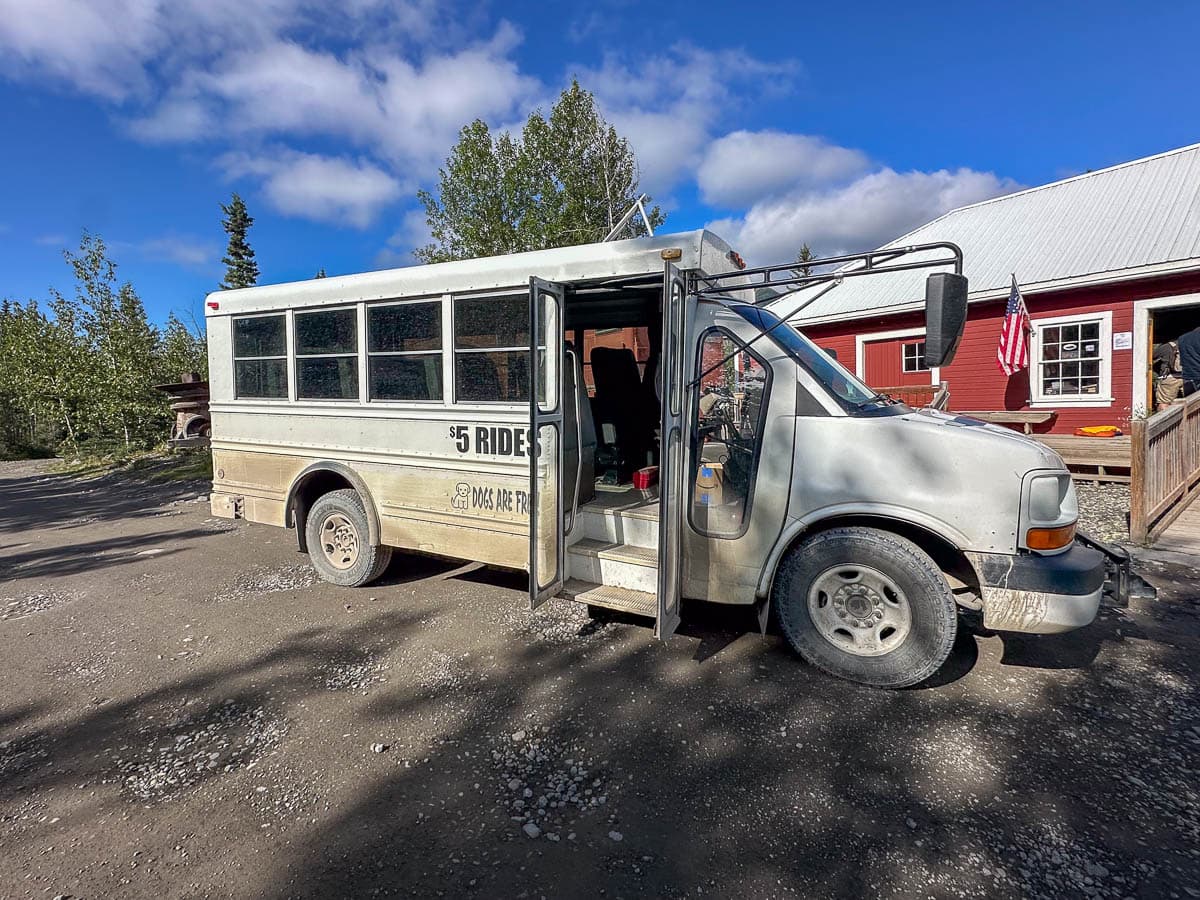
I’d suggest heading to the McCarthy Center Store, which sells passes for the Copper Town Shuttle and has its schedule posted. In our experience, the Blackburn Heritage Shuttle was a little bit more hit-or-miss, but it usually leaves from the McCarthy Kennicott Historical Museum to Kennecott, on the hour.
Once you’re dropped off in Kennecott, you simply walk north about a quarter of a mile to the Root Glacier trailhead. Easy peasy, lemon squeezy!
What to expect on the Root Glacier Trail
Despite being one of the most popular things to do in Wrangell-St Elias National Park, we didn’t think that it was very clear how to get from the town of Kennecott to the Root Glacier trailhead. So, I’d recommend just heading north through the town along McCarthy Road until you pass all of its buildings and see signs for the Root Glacier Trail.
Once you’ve walked 0.7 miles from town, you’ll reach an area with signs forking off to different trails, including the Jumbo Mine Trail and the Bonanzo Mine Trail, as well as a vault toilet, if nature calls.

Continue heading north along the Root Glacier Trail, with the trail gradually sloping upwards for the next 0.7 miles. On your righthand side will be a dense pine tree forest, while on your left hand side, you’ll have stunning views of the toe of the glacier and the surrounding Wrangell Mountains, including Mt. Blackburn, Regal Mountain, and Donaho Peak.
Once you’re about one and a half miles into the trail, it will start heading downhill. Keep a lookout for Jumbo Creek, which has a log bridge crossing and a beautiful waterfall, cascading down to the valley below.

About two miles in, the trail will fork again—if you head to the right, you can head to the Erie Mine, where you’ll find derelict ruins from one of Kennecott’s five mines high up in the mountains, or, if you head to the left, the Root Glacier.
Follow the trail along the moraine, which leads downhill to the edge of the glacier. This area is made up of crumbly soil and large, uneven rocks, with steep drop-offs on either side, so be super careful and watch your footing here.
Shortly after the turnoff for the Root Glacier, the trail crosses over Amazon Creek, which, depending on glacial runoff and recent rainfall, can get super high and can even require wading through the water. When we visited in early August, this stream was WAY below the pathway, but, if you visit earlier on in the season, be prepared to walk through some seriously cold water.

After half a mile of walking on the moraine, you’ll finally reach the toe of the glacier.
If you want to walk on the ice, your best (and safest!) bet is to go with a guide. Glaciers are unpredictable and can collapse, shift, and move at any time, so walking on it, without the proper safety knowledge and gear, can be EXTREMELY dangerous.
Accordingly, I’d strongly recommend going with a knowledgeable guide, like on this half day tour. As an added bonus, you’ll get to learn a ton of fascinating history about the park, as well as the geology of the glacier itself and the surrounding landscape.
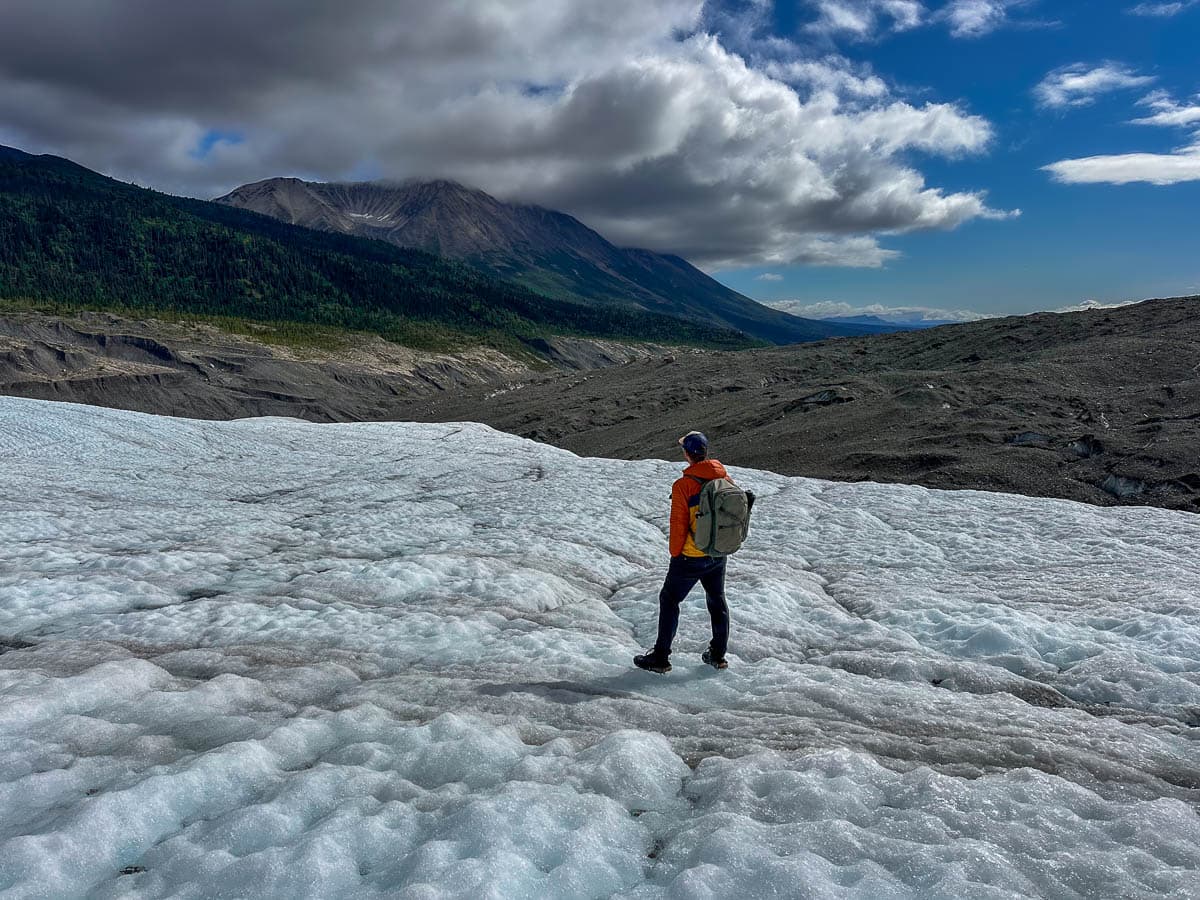
Alternatively, you’re free to walk by yourself on the glacier, although you absolutely need to have microspikes to not totally wipe out on the icy surface. Truth be told, we hiked on the glacier by ourselves and felt reasonably safe doing so, although, again, it would be SUPER easy to potentially hurt yourself—or worse—here.
Exploring the Root Glacier was SO cool. The landscape of the glacier was so beautiful, with swooping ridges, cliffs, and valleys, plus all of the pronounced striations, caused by rocks that get incorporated into the glacier as it flows and moves. Honestly, walking on the Root Glacier was easily one of the highlights of our three month stay in Alaska!
Once you’re done exploring the Glacier, simply retrace your steps back to the trailhead.
When to hike the Root Glacier Trail
Wrangell-St. Elias National Park is technically open year round.
However, McCarthy Road is not maintained from mid-October through mid-May and, thus, is closed during this timeframe from heavy snowfall.

You can still technically fly into McCarthy, but pretty much all services, including hotels, shuttles, restaurants, and shops, will be closed for the season.
Accordingly, I’d generally recommend visiting from June through September, when all of McCarthy’s services are up and running and the trail is mostly free of ice and snow.
Tips for hiking the Root Glacier Trail
Be bear aware
Wrangell-St. Elias is home to both black and grizzly bears, the latter of which is routinely spotted along the trail. So, it’s important for you to know what to do if you encounter a bear along the Root Glacier Trail.
Wrangell-St. Elias has this awesome guide, which tells you what to do if you run into a bear that’s demonstrating both non-defensive and defensive behaviors. You should also have bear spray with you, which is a way to deter but not seriously injure the animal if it acts aggressively towards you.
You can camp here
If you’re looking for a true Alaskan adventure, consider backcountry camping for a night or two along the trail. There are a handful of primitive campsites near Jumbo Creek. There are no facilities here, other than bear boxes to store your food and an outhouse, so you have to bring everything you need with you (e.g., tent, food, sleeping bags, water filter).

You are required to use the provided bear boxes or a bear canister to store your food here—remember to be super careful about bear hygiene while you’re camping!
Bring multiple layers of clothing
People always assume that Alaska is quite cold, even in the summer—but that definitely isn’t the case! When we hiked the Root Glacier Trail, it was decidedly t-shirt weather, with temperatures in the upper 70s and sunny skies.
As you might imagine, though, it feels pretty chilly when you’re directly hiking on miles upon miles of ancient ice. While we were climbing on the Root Glacier, I threw on a puffer jacket that I had packed in my backpack and still was on the colder side.

So be sure to wear a mix of airier layers with some warmer items to put on once you get to the glacier—it would be a shame to have to turn around early because you’re too cold!
Where to stay in Wrangell-St. Elias National Park
If you drive all the way out to the Root Glacier Trail, you’re probably going to want to stay for a day or two to explore the rest of the national park. I’d recommend staying in the town of McCarthy, which has a handful of shops, cute restaurants, and a more lively vibe than Kennecott.
There are a few accommodations to chose from in McCarthy, but pretty much all of them are owned by the McCarthy Lodge Resort. Here are some of the options they offer:
- Lancaster’s Backpacker Hotel: If you’re on a tighter budget, I’d suggest staying at this property that has hostel-esque vibes, with shared bathrooms, complimentary breakfast, and a social atmosphere.
- Ma Johnson’s Historical Hotel: This boarding house has operated for more than a century and now serves as the most bougie accommodations in McCarthy. Artifacts of the town’s mining heyday are perfectly balanced throughout the decor with more modern amenities, like memory foam mattresses, comfy bathrobes, and super soft sheets. The property refers to itself as a living museum, which sounds SO fun—this would totally be my pick of where to stay in McCarthy!
- Kate Kennedy House: Dating back to the 1920s, this two bedroom house also offers a cool mix of antiques from McCarthy’s past, including a working Victrola, with amenities to make your stay super comfortable, including a fireplace and coffeemaker.
- Rose House: Wanna stay in a former bordello? This four bedroom house has been updated to be much more wholesome, as compared to its seedier past, with two patios and comfy bathrobes to lounge around in.
- Bluebell: If you’re not into the old timey vibes, this modern two-bedroom apartment is your best bet, with a fully equipped kitchen (which is hard to find around these parts!), working fireplace, and balcony that overlooks McCarthy’s streets below.
You can book any of these properties with the McCarthy Lodge Resort
We hope you have an awesome time on the Root Glacier Trail—it really was one of our favorite experiences during our summer in Alaska! Do you have any questions about hiking this trail? Let us know in the comments below!
