

Hatcher Pass, located in the Talkeetna Mountains, is one of the most stunning areas around Anchorage, Alaska, with snow-capped mountains, tundra dotted with wildflowers, glaciers, and technicolor lakes. If you want to explore this area for yourself, the challenging Reed Lakes Trail is one of the best options, taking you up to two glacial lakes and one of the most stunning views in all of Alaska. In fact, my husband, Justin, and I spent an entire summer exploring the state and this was actually our favorite hike in all of Alaska!
If you want to tackle this incredible hike for yourself, here’s everything you need to know about the Reed Lakes Trail.
This post may contain affiliate links. If you make a purchase through them, we may receive a small commission, for which we are extremely grateful, at no extra cost to you.
About the Reed Lakes Trail
Here are some quick stats about the Reeds Lake Trail:
- Length: 8.8 miles
- Elevation gain: 2,283 feet
- Difficulty: Difficult
- Trail map
- Dog-friendly? Yes, but I’m not sure that I’d recommend bringing smaller dogs or ones that aren’t accustomed to hiking. A lengthy section of the trail is through boulder field that you need to scramble over, which can be pretty challenging—I could definitely see a dog getting easily hurt here.

How to get to the Reed Lakes Trail
The trailhead for the Reed Lakes Trail is located here in the Hatcher Pass State Recreation Area, with over 300,000 acres of alpine wilderness. Hatcher Pass is one of the best things to do near Anchorage, with everything from scenic drives and gorgeous hiking trails to one of the best examples of a 20th century gold mine.
It’s located about an hour and 20 minutes north of the city of Anchorage or 35 minutes from Palmer or Wasilla.
Most of the drive from Anchorage is along paved and well-maintained roads, but once you reach the Archangel Creek Bridge, about half a mile from the trailhead, the road becomes full of potholes and large rocks. We didn’t have an issue driving on this portion of the road in our high clearance SUV, but if you have a low clearance vehicle, I’d suggest parking before the bridge and walking to the trailhead.

If you feel comfortable driving past the bridge, there is a small dirt parking lot directly by the trailhead, but if that’s full, there are several overflow lots and pulloffs alongside the road that you can park in.
It costs $5 per car per day to park here, which you can pay via credit card at the machines near the trailhead.
There is no vault toilet or any other kind of facilities by the trailhead, so be sure to use the restroom before your drive and bring all of the water that you need with you.
When to hike the Reed Lakes Trail
The Reed Lakes Trail is best hiked from July through mid-September, when the trail is mostly snow and ice-free.
Outside of this window, there is typically a fairly heavy snow-pack along the trail. We hiked the Reed Lakes Trail on July 11 and the upper of the two lakes found along the trail was still frozen and covered with snow.

The road you take to reach the trailhead, Archangel Road, is typically closed from September 15 to July 1. You can technically still hike the Reed Lakes Trail during this timeframe, but you’d have to park in this trailhead and add about five miles roundtrip to your hike.
There’s also multiple avalanche shoots along the trail, so, when there’s any kind of significant snowfall on the trail, I’d only recommend hiking on it if there’s a low avalanche risk that particular day and you have the appropriate avalanche safety knowledge and gear, like this avalanche kit.
What to expect on the Reed Lakes Trail
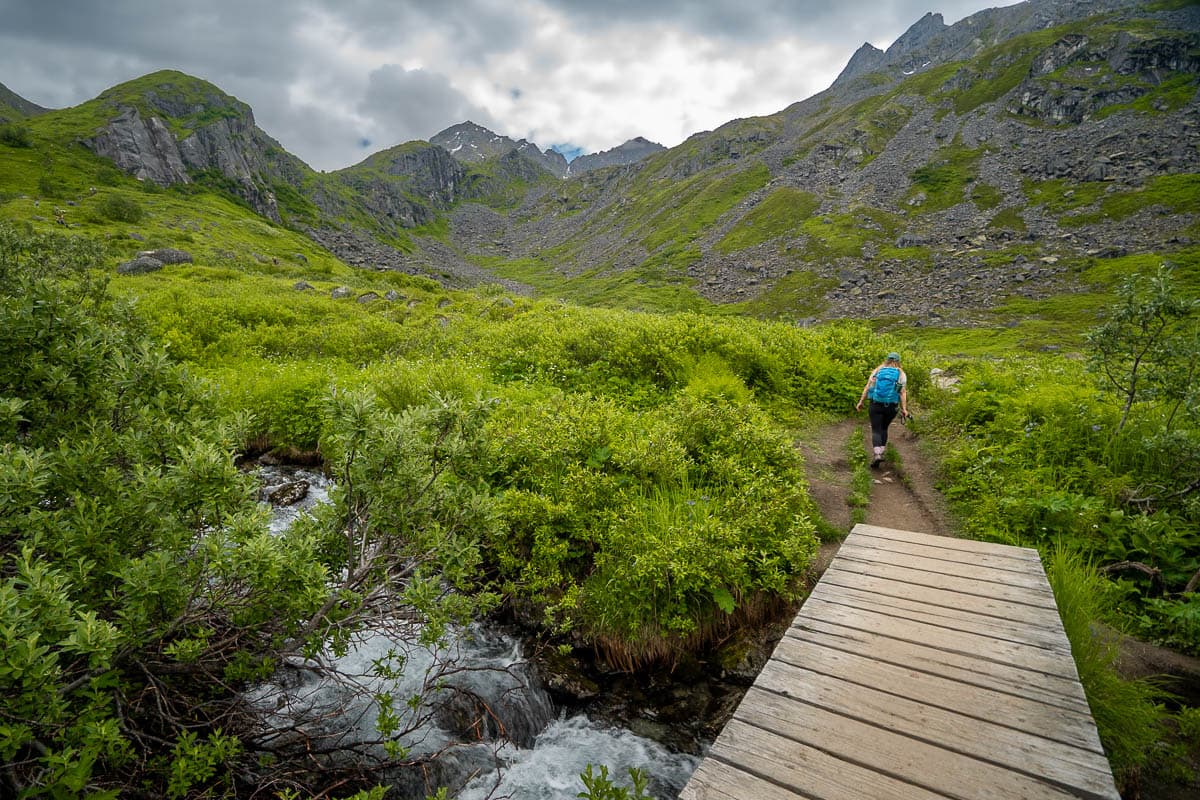
From the trailhead, the first 1.7 miles of the Reed Lakes Trail is easy, with a very gentle slope upward. The pathway meanders through a valley full of dense brush and surrounded by the snow-capped Talkeetna Mountains.

About 1.5 miles in, you’ll reach a fork—the path to the left hand side leads to the Snowbird Trail, but we’re going to stick to the right, along the Reed Lakes Trail. Shortly after this fork, you’ll pass a beautiful waterfall and cross a wooden bridge over Glacier Creek.
From here, the dirt pathway gets noticeably steeper, as you follow a series of tight switchbacks up a hillside.
Once you reach the top of this hill, the pathway basically disappears into a massive boulder field, with a crystal clear creek trickling through the rocks.

We found this section, which lasts for approximately 0.4 miles, to be pretty confusing—there’s no established trail here and it can, at times, be disorienting which direction you’re supposed to go. Additionally, there are sections where there’s large clearings in the boulder field, forcing you to decide whether or not to cross the stream there.
When you first reach this boulder field, you’ll be on the right side of the stream, but when you finish this section, you’ll need to be on the left side of it. Accordingly, you theoretically only need to cross the stream one time.
On our way heading to the lakes, we wound up crossing it multiple times, but on our way back down, we crossed it as soon as we entered the boulder field and stuck to the left side of the stream the whole time.

As far as I know, there isn’t a right or wrong way to do it. But just be prepared to go slow, as the rocks in this section can move around and be slippery, and to have an offline map downloaded on AllTrails, in case you get turned around.
Once you’re done with the boulder field, the path mellows out again, following along the crystal clear waters of Reed Creek. Plus, the views keep getting better and better, as you hike deeper into a bowl of mountains.
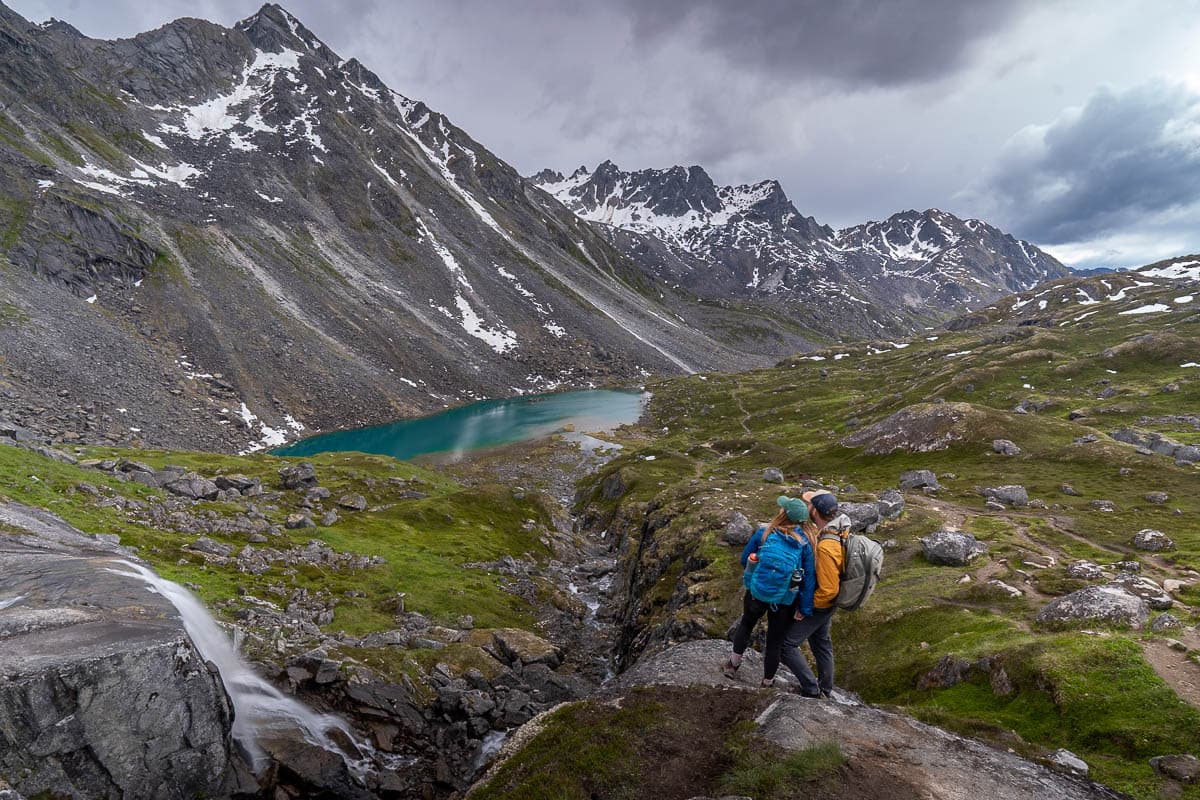
About half a mile after the boulder field, you’ll reach the turquoise waters of the gorgeous Lower Reed Lake, framed by craggy Turnkey and Outpost Peaks towering in the background. It’s seriously one of the most stunning landscapes that we’ve seen!

Personally, though, I think the lake is even more stunning from above, as you continue on the trail. For about 0.4 miles, the trail climbs up a fairly steep hill, until you reach a ridgeline, with a waterfall cascading down a cliffside to your right handside. Be sure to turn around and take in the views here—it’s gorgeous!
After the waterfall, the trail flattens out and passes several beautiful clear pools, formed by Reed Creek, until you reach the Upper Reed Lake. As mentioned above, it was still frozen over when we visited in mid-July, but it’s supposed to have a similar milky turquoise hue as the lower lake. We’d definitely love to come back some day when we can appreciate the upper lake in all its glory.

Once you’re done soaking in the views here, simply turn around and retrace your steps back to the trailhead.
Things to Know Before Hiking the Reed Lakes Trail
There’s no cell service
There’s no cell service in a lot of the Hatcher Pass State Recreation Area, so I’d recommend downloading an offline map on Google Maps and on AllTrails before you hit the trail.

There are lots of social trails, turnoffs, and confusing portions of the trail, like the boulder field, so having an offline trail map is really handy to have, in case you get turned around.
Avoid this trail if it’s raining
I’m never a fan of boulder fields, but the one along the Reed Lakes Trail is pretty long, with huge, slippery boulders that shift around as you’re hiking on them. The boulders here get even more slick when they’re wet—it started raining when we were hiking back to the trailhead and we slipped on the rocks a LOT as we were climbing over them.

It would be super easy to seriously hurt yourself on this portion, even when the boulders are completely dry, so I’d recommend steering clear if it’s raining.
You can camp
If you want even more of an adventure, camping is permitted near both the Upper and Lower Reed Lakes, although you should always camp at least 200 feet from any freshwater source.
Be sure to try to find a campsite that looks like it’s already been established and regularly camped on to avoid negatively impacting the fragile tundra here.

There are also bears that live in Hatcher Pass, so following good bear hygiene practices, like cooking downwind from your tent and storing any items with odors in a bear canister, is important.
What to pack for the Reed Lakes Trail
One of our favorite things about hiking is that it usually doesn’t require that much special gear or preparation, but there is definitely a few things you should be sure to pack with you.
Waterproof hiking boots
I would strongly recommend leaving your sneakers at home and wearing actual hiking boots on this trail. Certain sections can get pretty muddy and there’s multiple water crossing where your feet might get wet, so I’d recommend finding waterproof ones, if you can swing it.

I’ve used these boots for years and LOVE them and Justin swears by these.
Bear spray
Hatcher Pass is home to both black and grizzly bears. These creatures will usually mind their own business, but may become aggressive towards humans if they perceive your behavior as threatening or if they’re protecting their young.
Accordingly, make sure you stay alert on the trail, are aware what you should do if you spot a bear on the trail, and carry bear spray, in the unlikely event that a bear tries to attack you.
Sunscreen
There’s really no shade along the trail, so be sure to bring some sunscreen to protect yourself against the Alaskan sun (which can be harsh, from time to time!).
Bug spray
There’s always that running joke about mosquitoes being the state bird of Alaska. We honestly didn’t find mosquitoes too bad anywhere in the state, but your mileage may vary.
Trekking poles
I’d suggest bringing collapsible trekking poles that you can tuck away in your backpack while you’re scrambling over the boulder field and bust out when you’re hiking on the other steep sections of the trail (I know my knees were glad that I had brought them along!).

I hope you enjoy the Reed Lakes Trail—it’s seriously such a fun and GORGEOUS trail and was absolutely one of the highlights of our three months in Alaska. Do you have any questions about hiking the Reed Lakes Trail? Let us know in the comments below!
